
Ophthalmic lenses in the EU PFAS debate
Exempt or not? An interview with Carsten Leutloff

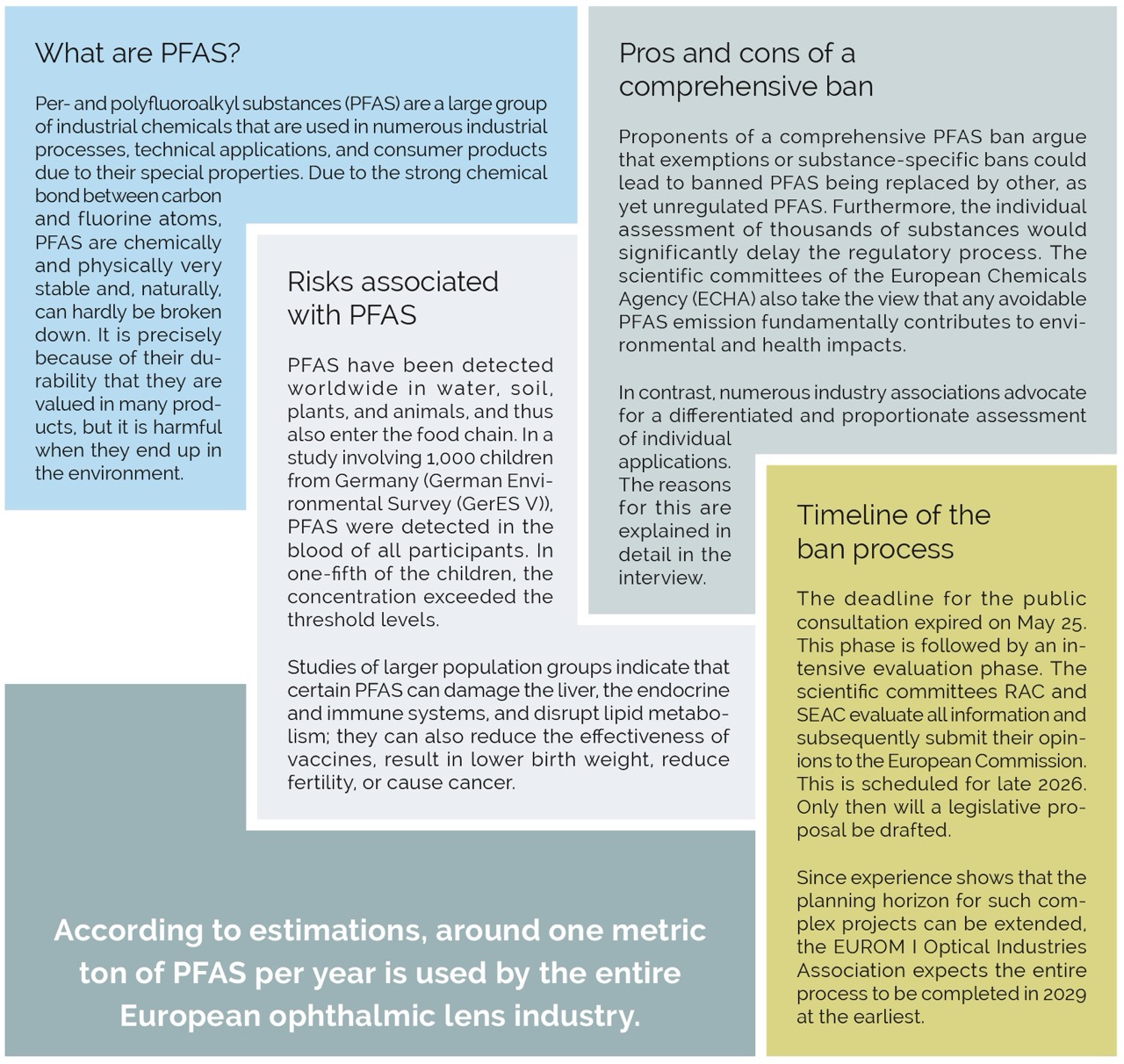
In the EU, the European Commission is currently discussing a blanket ban on the entire PFAS group of substances. According to the industry associations EUROM 1 Optical Industries and Spectaris, such a ban would have significant implications for ophthalmic lens manufacturing and development, even though only trace amounts of PFAS are used in the coating process during lens production. MAFO has spoken with Carsten Leutloff of EUROM 1 Optical Industries / Spectaris, who strongly advocates for an exemption for ophthalmic lenses as medical devices or, at the very least, for a transition period.
Since PFAS, also known as “forever chemicals,” accumulate in the environment as well as in humans, a comprehensive ban on this large group of substances is being discussed in the EU. Many industry representatives, however, argue against a blanket ban. To better assess the socioeconomic consequences, EUROM I Optical Industries commissioned a study that yielded some surprising results.

MAFO: Mr. Leutloff, what is the current status of PFAS regulation in the EU?
Leutloff: The PFAS restriction process is in its final scientific assessment phase. ECHA’s Risk Assessment Committee (RAC) adopted its final opinion in March 2026. The draft opinion of the Committee for Socio-Economic Analysis (SEAC) has already undergone public consultation, and SEAC is currently evaluating the feedback received. Its final opinion is expected by the end of 2026, after which the proposal will move to the European Commission and the Member States for decision-making.
MAFO: How might the potential regulation differ for ophthalmic lenses and contact lenses?
Leutloff: Although both are medical devices, they differ both in their application and in their regulatory classification. Ophthalmic lenses are Class I medical devices, whereas contact lenses belong to Class IIa. This shows that both product groups meet different requirements and should therefore be considered separately.
Meanwhile, we’re also seeing that the discussion at the European level has evolved. Initially, the focus was more on the idea of a very far-reaching PFAS ban. Today, it is increasingly recognized that medical devices require closer scrutiny, as patient safety and access to care must always be taken into account. For this reason, there is a strong expectation, for example, that an exemption might be granted for contact lenses. This issue is being closely monitored by our European partner association, Euromcontact.
When it comes to ophthalmic lenses, however, we face another challenge. I get the impression that, outside our industry, they are often perceived more as ordinary everyday products and less as what they actually are: custom-fitted medical devices that are essential for good vision – and thus for quality of life – for millions of people.
MAFO: Is the optical industry sufficiently recognized as a distinct sector in the negotiations?
Leutloff: No, unfortunately I don’t think so at the moment, because we’re perceived primarily as an industry supplying everyday products. People rarely consider that we’re dealing with medical devices and thus with highly functional and high-performance systems. Our industry knows this, but the perception among people outside our sector is different.
The prevailing opinion here is that, in principle, one could do without the coatings and would just have to clean them a bit more. But that’s a fallacy. Let’s consider a typical situation: You’re sitting in a car or on a bike; it’s afternoon, it’s fall, and it’s already getting a bit dark, and the weather isn’t great.
If your ophthalmic lenses are fogged up or dirty at that moment, it can lead to reflections, impaired vision, and perception problems. That poses a risk and we all get around using some form of transportation. The effects are difficult to quantify, but they’re there, and anyone who wears glasses knows that.
MAFO: Where are PFAS used in ophthalmic lenses?
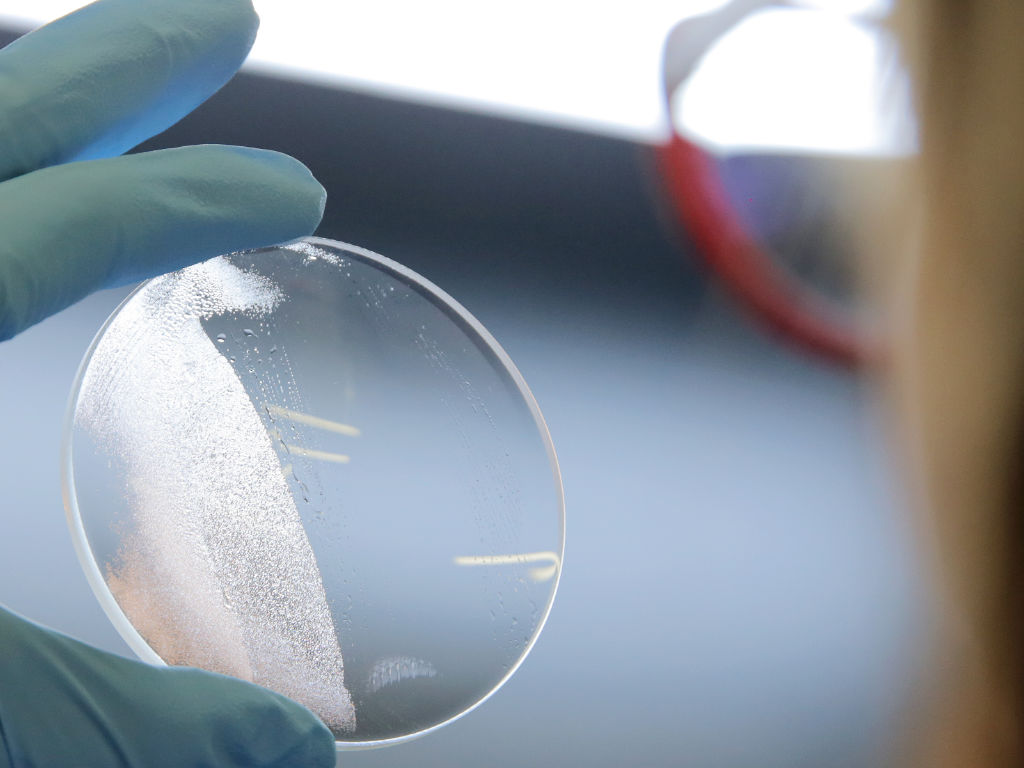
Leutloff: In all coatings with water- and oil-repellent properties – meaning easy-to-clean coatings and anti-fog coatings are affected.
However, it’s difficult to draw a clear distinction, as this also depends on the manufacturer and the product.
Furthermore, it is very important to address the quantities used. We’re talking about minute amounts of PFAS used in coatings, in some cases, just a few atomic layers. Accordingly, the consumption of these PFAS is relatively modest compared to other industries.
MAFO: How do you currently assess the situation regarding a ban on PFAS in ophthalmic lenses?
Leutloff: We use PFAS in ophthalmic lens coatings and, as things stand today, they are subject to this proposed restriction. At the same time, reliable sector-specific data has not been sufficiently available until now. This data has now been made available to the two committees, RAC and SEAC, so that they can issue an assessment.
We, the European umbrella organization EUROM I Optical Industries, believe that the data we provided during the consultation may lead to a change in thinking.
The data show that a blanket restriction would be disproportionate because, in a low-emission application such as ophthalmic lens coating, the economic and societal costs would significantly exceed the achievable environmental benefit.
MAFO: What shows your data about already available alternatives to PFAS?
Leutloff: There are alternative approaches, but as things stand today, they don’t come close to matching the performance of fluorine-based coating systems. This means that the alternatives won’t be able to meet all the performance criteria the industry sets for ophthalmic lenses at the same level.
A summary analysis of the alternatives that we conducted concludes that the lifespan of ophthalmic lenses without this PFAS-containing coating decreases by about 30% because the lenses would be harder to clean, surfaces could become compromised more quickly, and as a result, optical quality and comfort of use would suffer.
Technically speaking, the alternatives available today cannot be considered viable alternatives because they fall far short of standard performance criteria. For this reason, mineral glass is also not a realistic alternative for a great many applications.
MAFO: Is it possible to develop alternatives?
Leutloff: We’re talking here about the potential development of an entirely new group of substances and limited possibilities, since the selection of elements in the periodic table is limited. And even if there were alternatives that could match current performance levels, those alternatives would still need to be integrable into production processes.
To be honest, we don’t hold out much hope that viable alternatives will become available anytime soon. That’s why our analysis concluded that a transition period of at least twelve years would be necessary to give the industry any chance at all to search for alternatives with an open mind.
We don’t know whether the industry will find alternatives within that timeframe.
MAFO: What exactly were the results of your analysis of the socioeconomic impacts?
Leutloff: We concluded that, within ten years, a person who wears glasses would have to buy 1.1 more pairs of glasses. At first glance, that doesn’t sound like very much, but if you extrapolate that to the entire EU, we’re talking about a total – depending on the scenario – of up to 106 billion euros in lost welfare or additional burdens for users of ophthalmic lenses and society in Europe.
Now, one might casually say, well, the eyewear industry should be happy – it’ll just sell more glasses – but that’s not the point. Ultimately, such regulation does not primarily affect the industry, but rather the millions of ophthalmic wearers in Europe who would have to buy new glasses more frequently and bear the additional costs.
And when we consider the environmental impact, an extremely small amount of PFAS in a single lens would be offset by a significantly higher production of plastic lenses. The industry would have to produce far more ophthalmic lenses, and users would have to foot the bill.
The lack of proportionality becomes particularly clear when considering the abatement costs. Under the first scenario, our analysis estimates these costs at approximately 420–590 million euros per kilogram of PFAS emissions avoided. This demonstrates very clearly how small the additional environmental benefit is in relation to the resulting costs.
In addition, the analysis presents two different scenarios. One is, as described, that our optical industry can no longer use these products but instead uses only other PFAS-free coatings currently available.
A second scenario illustrates what it would mean if we could no longer produce these products here in Europe at all – if we had to completely cease production because the alternatives are not comparable to products from outside the EU and these would now have to be imported.
MAFO: The potential ban would also apply to imports, wouldn’t it …
Leutloff: Yes, the products would not be allowed to be imported either; that is theoretically correct. In practice, however, there is a risk that non-compliant products could still enter the EU market because controls at the EU’s points of entry do not function as comprehensively as they should. We’re all familiar with this from packages from China …
On top of that, from a purely technical standpoint, it is extremely difficult to detect a PFAS coating. You’d have to take the product to a lab and ask: Are there any PFAS compounds in this?
Furthermore, the analytical detection of PFAS on very thin coatings is technically challenging. The SEAC also points out the limitations of technical measurability and limited testing capacities.
It is therefore a great deal of uncertainty as to whether the products in question contain PFAS. Furthermore, if you do not know exactly which PFAS compounds are involved, you cannot precisely identify them. Laboratories would therefore need to know in advance exactly what they are looking for.
When you consider this difficult testing situation, you quickly come to the conclusion that it will likely be very difficult for regulatory authorities to determine whether the products comply with European requirements.
This, in turn, would lead to a structurally unequal competitive environment at the expense of European manufacturers and, as a result, to a significant loss of competitiveness for European companies. Depending on the scenario, the analysis estimates economic losses of up to 30 billion euros and up to 60,000 jobs at risk across Europe. These are figures that make me wonder whether we are willing to accept this despite the comparatively small PFAS emissions associated with this application
MAFO: Are you talking about one metric ton of PFAS in total?
Leutloff: Yes, we’re talking about an estimated annual use of around one metric ton per year for the entire European ophthalmic lens industry. This one metric ton is divided into approximately 500 kilograms of non-polymeric PFAS and 500 kilograms of polymeric PFAS. This is important for technical distinction. The non-polymeric PFAS are used in manufacturing and polymerize on the surface of the ophthalmic lens. There, only the polymerized PFAS remains as a very thin layer on the products and are sold.
So we’re talking about an annual use of around one metric ton of PFAS in the European ophthalmic lens industry, which comes at a very significant economic and social cost. I consider this disproportionate.
MAFO: Regulation of PFAS is also being discussed in other countries. Shouldn’t we lead the way as a good example for environmental protection?
Leutloff: This is how European politicians often argue. To paraphrase: In Europe, we can assume that a very far-reaching ban will be adopted in many parts of the world. Personally, however, I consider this to be simply a mistake.
Yes, there is ongoing discussion about PFAS in the U.S. and around the world. But PFAS will never be banned across the board. There is always a risk assessment of the consequences a ban would have for a specific industrial sector – and that is also the case in the U.S.
Most often, such bans initially affect products intended for everyday use. Or can you imagine a substance being banned in the U.S. that is needed, for example, in the military sector?
And the chemical industry isn’t just in Europe – it’s global. If other countries see that the chemical industry in Europe is no longer producing these substances, that’s initially a market opportunity.
Then there are countries with significantly lower environmental and enforcement standards that will promote buying these products from them. This leads to environmental impacts in those countries – and since we only have one Earth, that should certainly concern us.
Hence the counter-question: Might it make more sense to produce PFAS here in Europe, using a safe process, rather than somewhere else in the world?
MAFO: Are there ways to optimize the processes so that less PFAS ends up in the environment?
Leutloff: It’s very important to ECHA and the Commission that we look at the entire product life cycle. To the industry, for that matter, as well.
If you break it down roughly, you first have the production of the raw materials by the chemical industry, which supplies the material. Then there’s the processing stage in ophthalmic lens production. Next comes the service life, during which the lenses are used by opticians and patients, followed by the disposal phase.
During the production phase of ophthalmic lenses, PFAS emissions are considered very limited, as the relevant coating processes take place under controlled conditions.
The materials are processed exclusively in a closed-loop system under vacuum. Appropriate high-temperature incineration under controlled conditions can destroy PFAS. The same applies to the disposal phase, since the plastics are mostly incinerated here. Incinerating these substances leads to their destruction. This means that PFAS become problematic when they are not incinerated and end up, for example, in a landfill. In a landfill, they would remain very stable, enter the environment, and not be broken down by further environmental influences.
And during the actual use phase, according to current understanding, polymerized PFAS do not represent a relevant source of exposure for patients when used as intended – this, too, is the general consensus. You can continue to use your rain jacket, your Gore-Tex shoes, and your ophthalmic lenses.
MAFO: In your view, how important is a differentiated application-specific regulation rather than a blanket ban on substances?
Leutloff: This is a key demand: that we consider issues on a product-specific and application-specific basis.
Take a pacemaker, for example: if materials or coatings containing PFAS are used there, it is because they are necessary for the safe functioning and biocompatibility of the medical device. In our view, such applications must be assessed differently than, for example, PFAS in firefighting foams, which are intentionally released in large quantities directly into the environment. A distinction should be made here.
This is precisely why we advocate for differentiated, application-specific regulation that takes into account both the risk of release and the respective benefits of the application.
MAFO: What arguments are you particularly trying to emphasize to EU policymakers?
Leutloff: That ophthalmic lenses are highly functional medical devices and not merely ordinary everyday products.
The second point is that our application is quite low in emissions, both during manufacturing and during use. And third, that the costs of avoidance are significantly high and therefore disproportionate.
MAFO: We haven’t yet discussed the issue of innovation – what impact would the ban have here?
Leutloff: If we look at the global ophthalmic lens market, Europe is currently one of the leading regions in terms of technology. Our manufacturers enjoy an excellent international reputation – not only because of specific coatings, but above all due to the high quality, durability, and performance of their ophthalmic lenses. It is precisely this strength that is at stake.
If the industry were forced to switch to alternatives that are not yet equivalent in the short term, this would have a noticeable impact on product quality and, consequently, on the competitiveness of European manufacturers. In the worst-case scenario, production capacities and investments could be shifted to regions outside Europe.
That is why, in our view, the issue is not about delaying innovation, but about making it possible in the first place. A transition period of at least twelve years would give companies the necessary leeway for development and investment to create high-performance and sustainable alternatives.
Whether these will ultimately achieve the same performance cannot be said with certainty today – but without sufficient time, this development is unlikely to succeed.
Europe now has the opportunity to continue playing a leading role in innovative high-performance coatings. To do so, however, we need a regulatory framework that promotes innovation rather than hindering it with unrealistically short deadlines.
Europe currently enjoys an excellent global reputation for high-quality ophthalmic lenses and innovative coating technologies.
If European manufacturers were forced to offer products with lower performance, this could also damage our industry’s international reputation in the long term. A sufficient transition period, on the other hand, gives us the chance to remain among the global innovation leaders in sustainable high-performance coatings.
MAFO: Thank you very much for the interview, Mr. Leutloff.