Sustainability requires common standards

Key messages from the Frame the Future Catalyst study
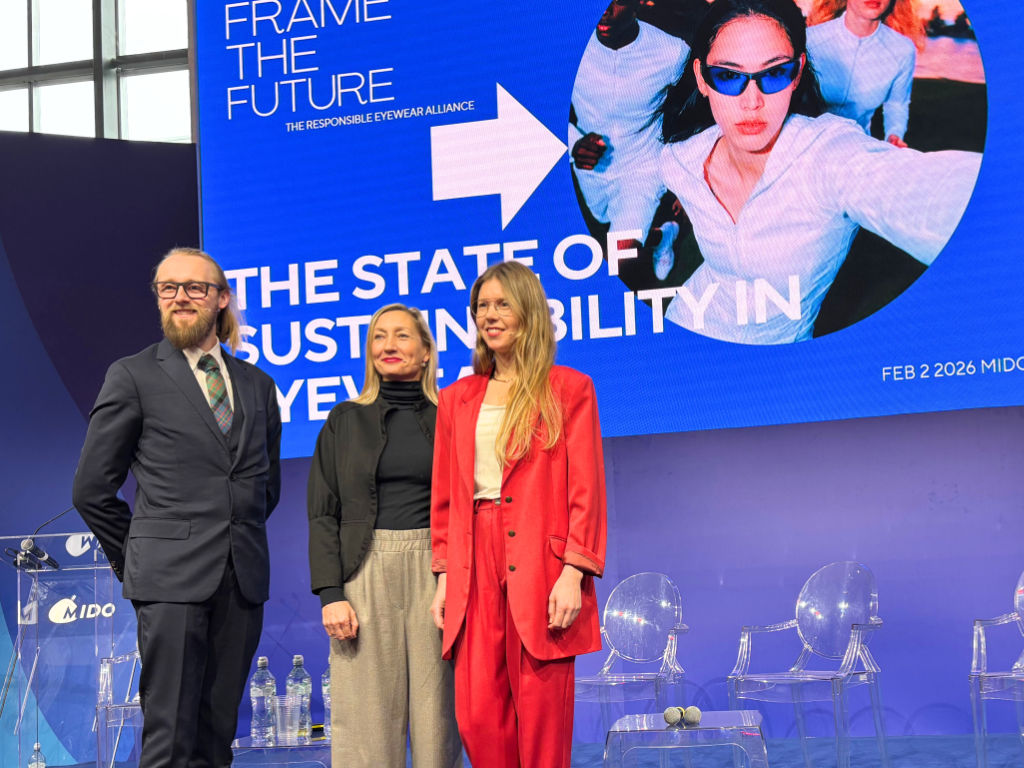
The ophthalmic optics industry is facing a transformation in the area of sustainability: New ESG guidelines, increasing transparency requirements, and the boom in smart glasses are creating greater pressure to act. At the same time, the topic has the potential to drive innovation. The Catalyst study by Frame the Future shows that there is no shortage of ideas, but rather a lack of common standards. Why sustainability is becoming a strategic issue for the future and why collaboration could become a decisive factor for success.
The global eyewear industry has reached a defining moment. Sustainability is no longer optional. It is shaped by regulation, supply-chain risk, retailer expectations, access to capital, and failing consumer trust. Credibility in 2026 is defined by proof – not promises.
The regulatory horizon is accelerating
Beyond CSRD (Corporate Sustainability Reporting Directive) and PPWR (Packaging and Packaging Waste Regulation), upcoming Green Claims legislation, Ecodesign for Sustainable Products Regulation (ESPR), and DPP (Digital Product Passport) implementation will progressively require verifiable product-level data. Voluntary narratives are being replaced by enforceable standards.
Sustainability risk is increasingly financial risk. Lenders and investors are integrating ESG exposure into capital allocation decisions, credit conditions, and valuation models. Insurance providers are beginning to assess supply-chain resilience, climate exposure, and compliance risk as underwriting variables.
While sector-specific data remains limited, the direction of travel is clear: unmanaged sustainability risk may translate into higher cost of capital and restricted market access.
Yet the core challenge in eyewear is not intent, it is fragmentation. Across materials, manufacturing, laboratories, brands, and retail, efforts remain isolated. Data is inconsistent. Standards vary. Costs are duplicated. Progress is slow. The result is not a technology gap – but an alignment problem.
Structural barriers
The following six structural challenges were identified in the study.
1 | The data wall: Transparency stops where it matters most. Companies struggle to access reliable data beyond Tier 1 suppliers. Chemical composition, upstream waste rates, and carbon data remain opaque. Reporting requirements (CSRD, EPR, DPP, Green Claims) are accelerating – but traceability systems are fragmented. Core issue: Measurement expectations are rising faster than shared data infrastructure.
2 | The trust gap: Fragmentation inside, confusion outside. NDAs, supplier protectionism and duplicated audits limit collaboration. Inconsistent terminology (“bio,” “recycled,” “eco”) erodes credibility in the market. Retailers often lack the clarity and tools to communicate sustainability accurately. Core issue: Trust requires aligned standards – not isolated claims.
3 | The price trap: Sustainability competes with margin logic. Small cost increases at material level become amplified through retail mark-ups. Fossil-based materials remain the economic default. At the same time, companies increasingly view sustainability through an efficiency lens: reducing remakes, optimizing energy use, improving yield. Core issue: The core challenge is economic, not technological. Solutions already exist but scaling them requires shared demand and industry collaboration.
4 | The waste engine: Inefficiency is embedded in product architecture:
- 70–90% acetate offcuts
- High lens swarf
- Single-use demo lenses
- Mixed-material frames not designed for disassembly
- Packaging and POS waste recycling exists technically, but rarely at viable scale.
Core issue: Circularity cannot scale without manufacturing redesign and volume aggregation.
5 | The retail filter: Innovation does not automatically fly. Retail is the critical interface – and a bottleneck. Without standardized communication, training and infrastructure, sustainable innovation struggles to differentiate at point of sale. Take-back, repair and second-life systems remain fragmented. Core issue: Without last-mile alignment, upstream progress stalls.
6 | The hidden footprint: Systemic risks sit outside the main narrative. Logistics emissions, chemical exposure, energy mix variability, workforce resilience and regulatory preparedness remain unevenly addressed. Some impacts are underestimated; others are oversimplified (e.g., local production is not automatically lower carbon without scale efficiency). Core issue: What is not measured today becomes tomorrow’s risk.
Eyewear market structure and fragmentation
These issues show sustainability in eyewear must move beyond reporting toward system integration: Circular principles, viable business models, and meaningful measurement. However, what is missing today is coordination and this challenge can be explained by the market.
The global eyewear market was valued at about USD 200 billion in 2024 and is projected to grow strongly to around USD 336 billion by 2030 (CAGR 2025-2030: 8.6 %). The global eyewear industry is shaped by a small number of highly influential players, alongside a great many independent brands and specialists.
Groups such as EssilorLuxottica – with its vertically integrated model spanning lenses, frames, brands, and retail – hold a dominant share of global eyewear production and distribution. Other major actors, including Johnson & Johnson Vision Care, Bausch + Lomb, Carl Zeiss AG, and Hoya Corporation, play a critical role across lenses, vision care, and optical technologies.
At the same time, luxury and fashion groups such as LVMH and Kering are increasingly investing in eyewear – reinforcing its position not only as a medical device, but as a fashion and lifestyle product. From a sustainability perspective, this structure matters.
At the same time consumer concern for sustainability remains high. Engagement has stabilized rather than declined, even under economic pressure. Euromonitor reports that 61% of consumers globally are actively trying to have a positive environmental impact, consistent with recent years.
However, awareness does not automatically translate into behavior. A persistent intention – action (say–do) gap is widely documented. Key drivers include perceived effort, trust deficits, and unclear value at the point of purchase. The implication for eyewear is clear: transparency mechanisms must reduce effort, increase credibility, and translate environmental attributes into tangible consumer value. In addition, there are other new challenges in the market.
Smart glasses
As of early 2026, the smart glasses (wearables) market is entering a high-growth phase, with global valuations for 2025/2026 hovering around USD 2.8 billion to USD 5.98 billion depending on the specific technology included (e.g., audio-only vs. full AR). Analysts project this sector will expand at a Compound Annual Growth Rate (CAGR) of 15% to 25.7% through 2030, likely exceeding USD 10 billion by the end of the decade.
This makes smart eyewear not just a tech trend, but a critical sustainability story. Because compared with traditional eyewear, they introduce multiple layers of complexity that have implications across materials, production, use, and end-of-life that are not yet fully addressed.
Smart glasses are significantly more complex than conventional eyeglasses: They contain electronics and batteries, require more energy and materials, have shorter lifecycles, and thus make repair, recycling, and circular economy practices more difficult.
Therefore, the industry must begin to define shared design standards, modularity principles, and recycling pathways that encompass electronics, not just frames and lenses. If left unmanaged, the surge in smart eyewear could drive higher environmental impact per unit and systemic fragmentation, especially as volumes rise rapidly. This requires coordination across brands, suppliers, and recyclers for avoidance of a growing waste stream.
ESG maturity and reporting
Benchmarking reports reveal a massive disparity in ESG maturity across the sector. While top-tier players have integrated governance models where ESG policies are linked to strategic decision-making, many other firms lack structured reporting frameworks entirely.
This lack of transparency limits the visibility of progress and makes it difficult for consumers to distinguish between authentic sustainability and marketing rhetoric. Several leading players now disclose their environmental data through the Carbon Disclosure Project (CDP) — the world’s leading independent environmental reporting platform that helps companies measure and manage climate impact.
EssilorLuxottica, for example, has publicly reported through CDP and earned strong climate disclosure scores. A structural constraint lies in the LifeCycle Assessment methodology. Variation in system boundaries, emission factors, allocation rules, and assumptions produce results that are often incomparable.
This undermines decision-making, weakens claims credibility, and creates risk under Green Claims regulation. Without harmonized Product Environmental Footprint Category Rules (PEFCRs, or “PCRs”), LCA becomes a technical exercise rather than a decision tool. Certifications also help with comparability.
Eyewear certification
In 2024 ANFAO (The Italian Association of Optical Goods Manufacturers) and Certottica launched the first voluntary international Certified Sustainable Eyewear (CSE) program, to respond to growing demand for sustainable products and to underscore the progress already made by some industry players.
Based on ISO standards, it takes into account the entire life cycle of a product (frame and components) such as resource extraction, raw materials, production, distribution, use and disposal. This includes an awards program at Mido, and in 2026 is expanded by a new category: the CSE Corporate Award, which moves beyond single product certification to honor companies demonstrating the strongest overall commitment to ESG principles across their entire corporate policy.
In eyewear, credibility is built through several. proof systems: sustainability certifications (materials, claims, ESG) and regulated product compliance (medical device / safety contexts).
Conclusion: From compliance to innovation
There is no lack of goodwill in the optical industry; rather, the problem is fragmentation. Many stakeholders work in isolation on initiatives that affect either materials, manufacturing, optical labs, specific brands, or the optical retail sector.
This results in a patchwork of pilot projects, certifications, and isolated innovations. Only a few players integrate sustainability into their entire value chain. As a result, data is inconsistent, standards vary, and duplicate costs arise. What is missing are common approaches that transcend the boundaries of individual products or companies. There is, therefore, a coordination problem.
One practical response is the initiative convened by Frame The Future to develop Product Environmental Footprint Category Rules (PEFCR) for eyewear, bringing stakeholders together to agree on a shared method for measuring products’ environmental impacts across their life cycle. By aligning data requirements and calculation methods, the project aims to make assessments more comparable, support credible communication and help companies identify opportunities to reduce their impacts.
At the same time, sustainability is increasingly viewed as a driver of innovation and no longer merely as a compliance obligation. This signals a structural shift: Sustainability is increasingly moving into upstream areas such as materials science, product design, and life-cycle planning.
Investments are focused on new, environmentally friendly, and bio-based materials; circular design models; and digital traceability infrastructures that enable repair, resale, and recycling on a large scale. There are also many good examples of this in the optical industry.
As a result of rising production volumes and new products such as smart glasses, the challenges facing the industry are increasing. However, if the industry manages to agree on common standards, infrastructure, or circular design benchmarks, this will offer the opportunity to work toward scalable sustainability.
About Frame The Future
Frame the Future (FTF) is a young alliance of committed companies. They share the common goal of accelerating circular solutions, as well as systems and regulations that promote sustainability in the optical industry.
The study’s authors conducted research, held in-depth discussions with numerous stakeholders in the optical industry, and conducted qualitative interviews with 19 companies. The respondents came from across the entire value chain and were predominantly based in Europe.
The study’s authors emphasize that the survey is intended to serve as a snapshot of a heterogeneous industry and not as a representative study of the entire sector. The publication is intended, in particular, to stimulate dialogue and identify common starting points for greater sustainability in the optical industry.
On the following, you will find some examples of flagship projects mentioned in the study in the field of demo lenses and eyeglass lenses.
Demo-lenses current situation
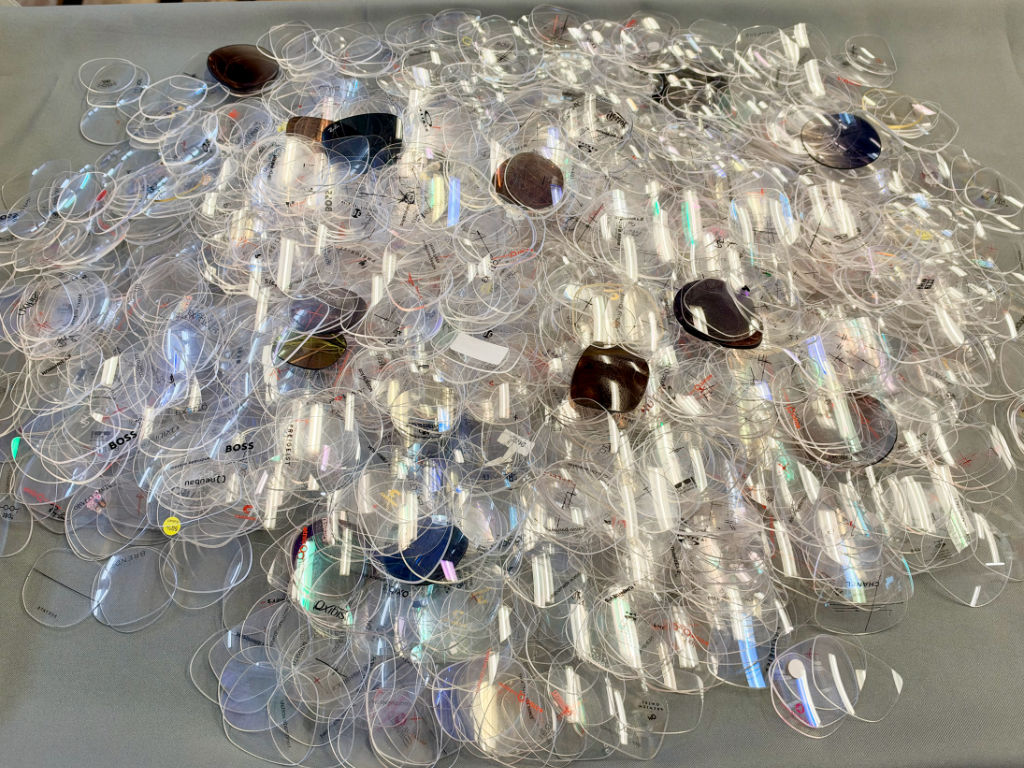
Demo lenses are clear inserts used to stabilize frames, display branding, and enable try-on. They are most commonly made from PMMA (acrylic), though polycarbonate (PC) and nylon blends are also used. They are removed at glazing – creating a pure linear waste stream.
Global estimates indicate the following figures: Approximately 5,000 to 5,500 metric tons of demo lens waste are generated worldwide each year (equivalent to approximately 600 million eyeglass frames per year). This amounts to billions of discarded units, of which only about 10% are recycled.
Case study one
Recycling technically proven
A 2025 French field study led by RecyclOptics, in partnership with IPC – Centre Technique de la Plasturgie and supported by ADEME and Région Île-de-France, validated the full industrial recycling chain for PMMA presentation lenses. The study confirmed:
- Optical sorting can isolate PMMA into high-purity streams
- Recycled PMMA can be extruded, pelletized, and injection molded
- Mechanical properties close to virgin PMMA
- Industrial scaling is technically viable
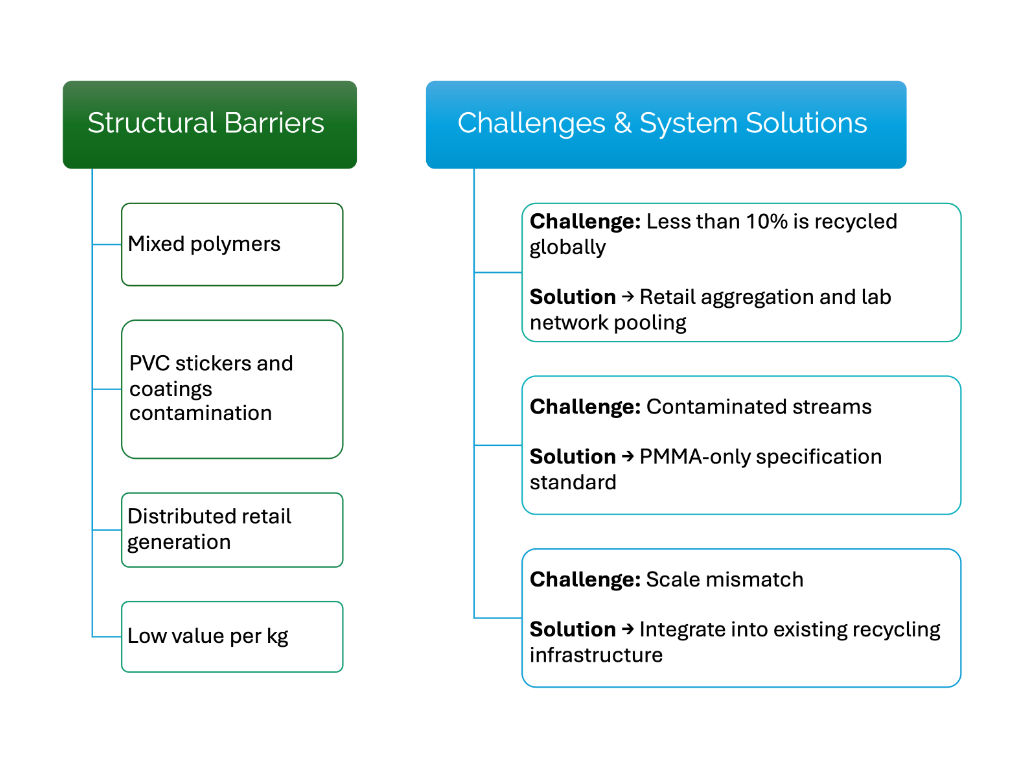
The bottom line is, the limiting factor is upstream organization and sorting quality – not material performance. Recycling is technically viable.
Case study two
Molecular recycling
Warby Parker and Eastman have been collaborating on a project since 2021. Eastman processes the demo lenses collected from Warby Parker’s U.S. laboratories at a molecular recycling facility in Kingsport. In 2024, for example, 16 metric tons were recycled there (up from 12 metric tons in 2023 and 9 metric tons in 2022). These were converted into an “Acetate Renew” raw material.
Case study three
Pilot on chemical recycling
The Pricon initiative, developed under IG Nachhaltigkeit in der Augenoptik, illustrates how demo-lens circularity hinges on system design. Pricon have undertaken a 600kg pilot batch of demo lens recycling via chemical recycling (pyrolysis) at Interzero Germany, proving the viability of the method for recycling impure PMMA lenses. The process worked but the pyrolysis operator requires 800-1000 tons per year for the process to be economically viable. But Germany alone only produces 60-66 tons of demo-lens waste per year.
The mismatch of scale is stark, though Pricon presents pyrolysis as a bridge solution for contaminated waste streams integrated into existing recycling infrastructure, with a longer-term goal of shifting towards PMMA-only demo lenses with minimal coatings. This would allow a gradual shift to preferred mechanical recycling once purity thresholds are met.
Ophthalmic lenses – current situation
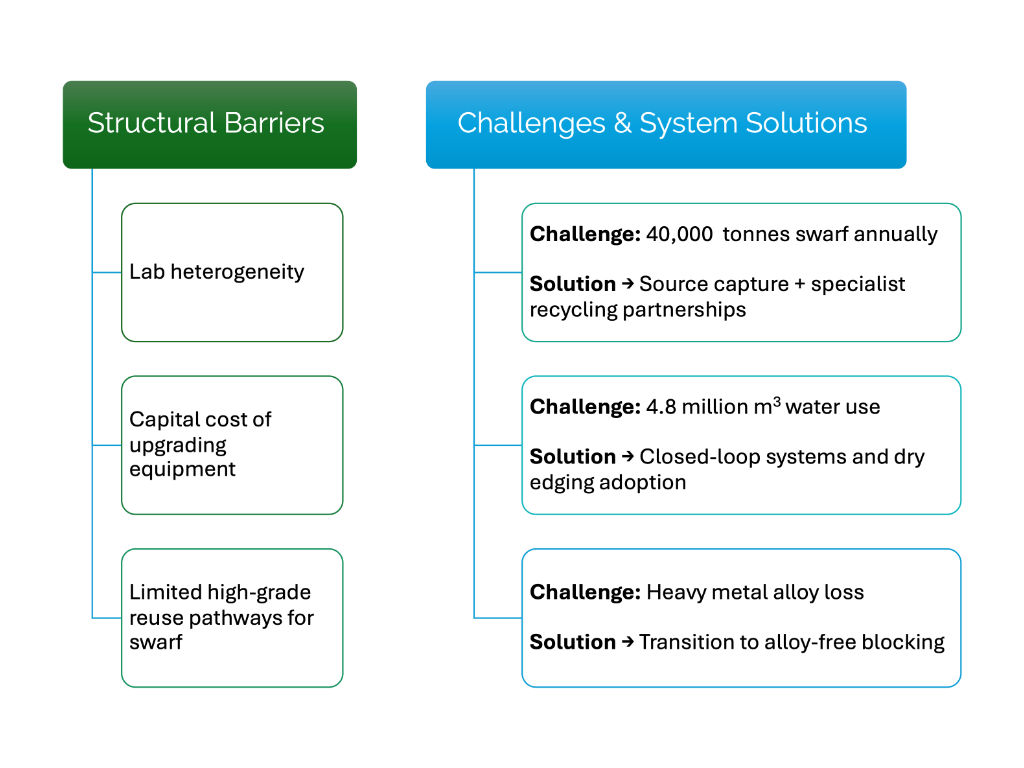
In 2021, Global Rx lens production was estimated at approximately 600 million lenses annually, with resource implications of:
- Estimated 4.8 million m. freshwater annually, equivalent to ~2,000 Olympic-sized swimming pools
- Estimated 40,000 tones of swarf annually
- Around 50% material waste in surfacing and glazing
- Estimated 37,400 kg alloy loss (heavy metals) in legacy blocking systems
More recent projections estimate global Rx lens production approaching three billion units and growing. Importantly, lens swarf generated during surfacing cannot currently re-enter the optical value chain at equivalent quality. Most recovered material is downcycled into lower-grade applications, if not destined for incineration or landfill. This limits true circularity and reinforces the need for upstream process innovation rather than downstream diversion alone.
Wet edging uses water as coolant and lubricant. Swarf enters wastewater streams unless captured. Closed-loop systems and dry edging technologies reduce water use and prevent discharge. Magnetic drive pumps + filtration can capture up to 80% of solids, reducing water consumption by ~40%. Without filtration, microplastic particles of swarf can enter wastewater. The MICRO-ALPS research initiative has explicitly linked ophthalmic lens production with regional microplastic pollution risk.
Traditional blocking alloys contain cadmium and lead, which can also enter wastewater. Modern surfacing technologies increasingly transition toward alloy free or reduced-toxicity systems, reducing potential heavy-metal discharge into wastewater streams.
Case study one
3D-printing filament
At Mido 2026, Certottica presented early results from MICRO-ALPS demonstrating:
- Conversion of lens grinding powder into 3D-printing filament
- Initial blends using 1–10% lens waste combined with virgin polymer
- Printable filament with viable processing behavior under laboratory conditions
- The ADMIRE Research Center (FH Kärnten) is testing mechanical and processing properties to evaluate application potential. Important: This remains a research and demonstration initiative, not a commercialized circular solution. The approach still depends on virgin polymer input and does not yet close the optical loop. It is significance lies in proving the technical recyclability of lens waste, raising awareness of microplastic discharge, and exploring intra-sector circular pathways.
Case study two
Recycling
Since February 2025, Hoya Australia has been sending swarf and offcuts to Opticycle recycling in Sydney, who have developed a process that creates a material used in pavers and bench tops. This demonstrates capture and diversion – though circular re-entry into optical-grade material remains limited.