
Preparing eyewear packaging for PPWR

From compliance risk to digital transparency

The EU Packaging and Packaging Waste Regulation (PPWR) is making packaging a compliance and market-access issue for the eyewear industry. As new requirements take effect, non-compliant packaging may require corrective action, withdrawal or recall, making early preparation increasingly important. This article is intended to serve as a practical roadmap for understanding new packaging requirements and preparing for a more circular and data-driven future.
For the eyewear industry, packaging has traditionally focused on product protection, presentation, logistics and cost. The EU Packaging and Packaging Waste Regulation (PPWR), Regulation (EU) 2025/40, adds another critical consideration: market access.
The regulation entered into force on 11 February 2025 and generally applies from 12 August 2026. It covers packaging and packaging waste across materials and sectors, introducing requirements for sustainability, labelling and waste management.
Why PPWR compliance matters
The consequences of non-compliance can go far beyond financial penalties. If an importer has reason to believe that packaging does not comply with applicable requirements, the packaging may not be placed on the EU market until it has been brought into conformity.
If non-compliant packaging has already been placed on the market, manufacturers and importers may need to take corrective measures, including withdrawal or recall where appropriate.
In addition, EU Member States must establish penalties for infringements that are effective, proportionate and dissuasive.
For eyewear companies selling into Europe, PPWR is therefore not simply an environmental requirement or a question of paying a fine. Non-compliant packaging can affect whether packaged products can legally reach or remain on the EU market.
The key question is changing from “Is our packaging sustainable?” to “Is our packaging compliant, and can we prove it?”
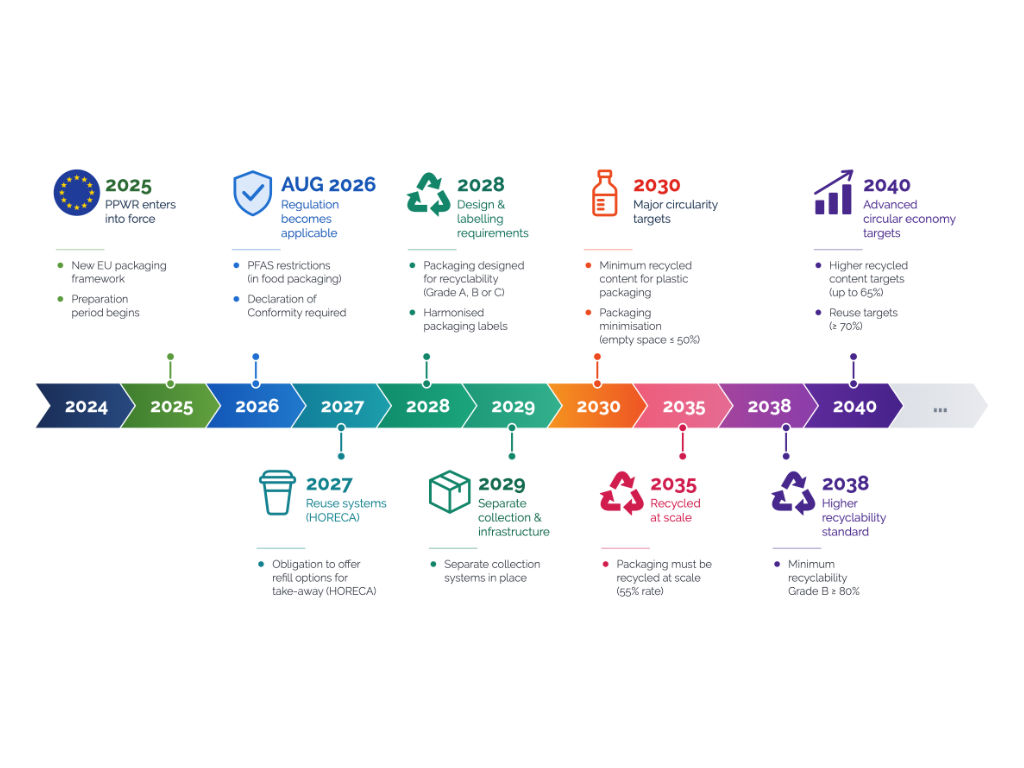
The PPWR roadmap: a gradual transition
PPWR should be viewed as a transition rather than a single deadline. Requirements become progressively more demanding as Europe moves towards more circular packaging.
A major milestone is 2030. Packaging recyclability will be assessed using performance grades based on design-for-recycling criteria.
Packaging below Grade C will be considered technically non-recyclable and restricted from being placed on the market. From 2035, assessment will also incorporate whether packaging is recycled at scale. From 2038, packaging will need to achieve at least Grade B to be placed on the market.
Other requirements develop alongside recyclability, including recycled content for specified plastic packaging, reuse, minimization and packaging information. For eyewear businesses, this transition can be understood through five key packaging priorities: recyclability, recycled content, chemical safety, reusability and minimization.
1 | Recyclability
Recyclability is at the center of PPWR. Packaging must be designed for material recycling and, under later requirements, be capable of being collected, sorted and recycled at scale.
For eyewear packaging, the complete structure matters. A presentation box may appear to be mainly paperboard but can also contain coatings, adhesives, decorative layers, plastic windows, magnets or inserts. These combinations may influence its recyclability.
As the requirements become stricter, recyclability will increasingly need to be considered alongside protection, presentation and cost when packaging is developed.
2 | Recycled content
Recycled content forms another important part of the transition towards circular packaging. PPWR establishes minimum post-consumer recycled-content requirements for specified plastic packaging categories, with certain exemptions depending on the packaging and its application.
This means recycled content is becoming more than a general sustainability claim. Reliable information about the material and its recycled-content percentage becomes increasingly important.
Instead of simply describing a material as “recycled”, businesses will need greater clarity about how much recycled material is present and what evidence supports that information.
3 | Chemical safety
Circular packaging must also be safe. PPWR maintains limits relating to the combined presence of lead, cadmium, mercury and hexavalent chromium in packaging and packaging components. The regulation also introduces restrictions on PFAS in food-contact packaging from 12 August 2026.
Not every chemical requirement applies in the same way to every eyewear packaging format. The relevance depends on the material and its intended application.
Nevertheless, the direction is clear: understanding the composition of packaging materials becomes increasingly important as sustainability and chemical safety need to work together.
4 | Reusability
Reuse is another important element of the circular packaging system. Reusable packaging must be designed for multiple rotations under normal conditions of use and meet relevant requirements concerning factors including safety and recyclability. PPWR also establishes reuse requirements for specified packaging categories.
However, this does not mean every eyewear package needs to become reusable. Different packaging types need to be considered according to their function and regulatory category. Transport packaging, for example, is an important area within the PPWR reuse framework.
The goal is therefore to apply reuse where relevant, rather than taking the same approach to every form of packaging.
5 | Minimization
The fifth priority is minimization. PPWR requires packaging weight and volume to be reduced to the minimum necessary while maintaining functionality. Marketing and consumer acceptance alone do not justify additional packaging weight or volume.
This is particularly relevant for premium eyewear packaging, where presentation can form an important part of the customer experience.
Minimization does not mean removing all premium features. Instead, unnecessary material, excessive dimensions, additional layers and empty space require closer consideration.
For applicable grouped, transport and e-commerce packaging, PPWR establishes a maximum empty-space ratio of 50% from 2030.
The objective is therefore not simply less packaging, but less unnecessary packaging while maintaining its essential function.
From five priorities to reliable evidence
Although these five priorities address different aspects of packaging, they share one important requirement: evidence.
Knowing that a package contains recycled material, uses a simpler structure or meets a particular requirement is only part of compliance. Businesses also need information capable of supporting those conclusions.
PPWR reinforces the importance of conformity assessment and technical documentation. Manufacturers have responsibilities relating to the EU declaration of conformity, while suppliers must provide manufacturers with the information and documentation required to demonstrate compliance.
For eyewear companies, this information may cover multiple packaging components and suppliers. Material specifications, recycled-content evidence and other relevant compliance records therefore need to be connected clearly with the correct packaging.
The purpose is not to generate more paperwork. It is to create a reliable relationship between the physical packaging and the evidence behind it.
Digital information and the digital product passport
The importance of reliable packaging data is also connected to a wider move towards digital transparency.
PPWR itself introduces digital elements. Reusable packaging covered by the relevant requirements uses QR codes or other standardized, open digital data carriers to provide further information about reusability and reuse systems. The regulation also provides for digital marking in relation to substances of concern.
Alongside this development is the broader EU move towards the Digital Product Passport (DPP).
The distinction is important. PPWR does not mean that every eyewear package automatically requires its own DPP. However, where other EU legislation requires product information through a digital data carrier, PPWR provides for relevant packaging and product information to use a single data carrier.
For the eyewear industry, the practical message is simple: prepare the data before focusing on the technology.
A QR code is only an access point. It provides limited value if the underlying material, recycled content or compliance information is inaccurate or incomplete.
The transition can therefore be understood as:
Understand the packaging → organize the evidence → maintain traceability → prepare for digital transparency.
It may be beneficial for companies to seek assistance with implementation and ensuring compliance. BD8 is one of the companies that provides support in this field.
The Hong Kong-based sustainable packaging supplier combines packaging solutions with supporting evidence. BD8 aims to help customers respond to changing packaging expectations while building stronger visibility over materials and compliance information.
Conclusion
PPWR marks an important change in how packaging is considered in the eyewear industry. Recyclability, recycled content, chemical safety, reusability and minimization are no longer only sustainability considerations, but increasingly part of the regulatory framework surrounding packaging.
For businesses placing packaged products on the EU market, the impact can be significant. Non-compliant packaging may not be placed on the market until it is brought into conformity, while packaging already on the market may require corrective action, withdrawal or recall.
This is why PPWR deserves attention across the eyewear supply chain. It is not simply about making packaging more sustainable. As the requirements develop, packaging compliance can directly affect whether products can enter and remain on the EU market.
Do not wait until market access becomes a problem, make PPWR awareness part of your packaging strategy today.