
Horizons: Brave new virtual world
VR glasses in ophthalmic optics

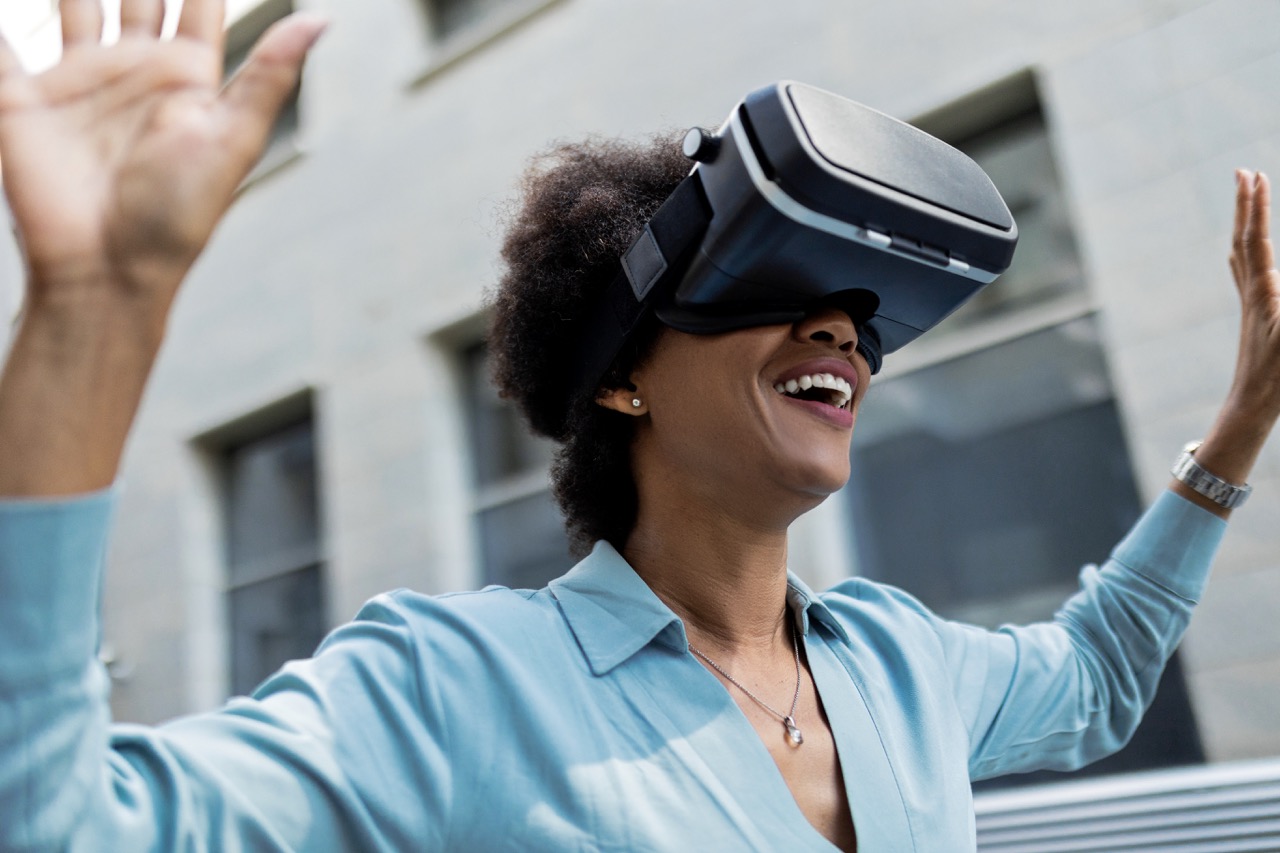
VR glasses are not only an exciting gadget for gaming but also serve as a new tool for collecting measurement data and for visualizing complex relationships. This can also be used profitably in ophthalmic optics. Santiago Soler from Horizons Optical explains in an interview how and why virtual reality (VR) improves the individualization of lenses and the buying process at the optician enormously. The lens design company pioneered the use of VR in the industry to create lenses that are fully tailored to each individual user.
The young company Horizons Optical has made a name for itself with its innovative technologies. One special tool is its VR glasses that can be used for several different applications.
The Spanish company, headquartered in Barcelona, was founded in 2017 by Santiago Soler as a spin-off from Indo Optical. Today, the company has 55 employees. It has another branch in the USA and the Asian and Latin American markets are served by additional local staff. MAFO has spoken to the founder about the use of VR in ophthalmic optics.
MAFO: Your company focuses on new technologies and innovation. Which role does virtual reality play in this concept?
Soler: Virtual reality is very important for us. When we started the company, we thought that we needed a parameter which had a significant impact in the lens preference and performance. There were already solutions for personalized lenses and lifestyle solutions on the market, but we were looking for something that was more impactful when it comes to performance. We came up with the concept of measuring gaze dynamics to improve our unique lens designs.
This concept is also well known in other industries. Think about professional athletes for example, they measure the way the athletes run for making running shoes which improve their running path. With vision you can make an analogy by measuring the way people look. Then we supply people with progressive lenses tailored to their way of looking which improve their visual performance.
Therefore, virtual reality plays an important role for us. It is a measuring device, to measure gaze dynamics with repeatability and accuracy in a proper way, but we also expanded its use to other solutions.
MAFO: Are there any challenges associated with the use of those new technologies in your devices?
Soler: In the beginning, the technological challenge was how to measure gaze dynamics in a proper way. We did some tests with eye trackers and other systems, but these were not ideal solutions.
Virtual reality though proved to be the ideal solution because you can control everything. You control the lighting, and you make sure that there is no distraction. The test is always the same and you can repeat the test no matter the hour of the day and no matter where you are.
And thanks to that, we can guarantee that the measurement of the gaze dynamics will be accurate, which is essential when using the resulting data to create top-tier progressive lenses.
MAFO: How do you make sure that the people will look like in real life, especially as you test only a short time period?
Soler: It’s a dynamic, game-like test. The user naturally relaxes and simply follows a moving object. Because there’s no need to hold a fixed position, eye movements happen in a completely natural way.
The system measures how you are moving your head and how you are moving your eyes in the different distances, like distance, intermediate and near. That information is recorded in order to be combined with the algorithm which creates the lens design which is fully adapted to you.
MAFO: Did you find huge differences between how the people are looking in terms of gaze dynamics?
Soler: Yes, absolutely—and it’s very interesting. In some cases, you can even observe patterns related to personality. For example, people who are more shy tend to keep their body relatively still, which often leads them to rely more on eye movements. By contrast, people with a more open personality tend to move their body and head more, and as a result, they rely less on eye movements alone.
MAFO: How did the idea for the VR-simulation mimesys came about?
Soler: In one of the meetings, we had with the Polytechnic University of Catalonia (UPC), we discussed the buying process at the optician, and that this process is often kind of boring. At this meeting, the idea occurred: imagine you are going to buy your lens in the optical store and the optician puts the virtual reality headset on! Then you will make this fascinating test and follow a bird or drone.
At the end, the system not only captures valuable visual data but also shows you how you would actually see with progressive lenses. We immediately realized this could be a powerful and differentiating tool. At the time, no one in the industry was using virtual reality in this way, and we saw an opportunity to introduce a truly disruptive customer experience.
MAFO: What changes for the process at the optician’s store?
Soler: For the optician there is an important change in the dispensing process. When people should decide whether they buy a top or intermediate or basic progressive lens, this is the right moment for making the test for measuring their gaze dynamics and for using the virtual reality and mimesys for other purposes.
Because in the process of purchasing a progressive lens, there are many abstract concepts involved, like aberrations or like astigmatism. However, the consumers are not familiar with these words or concepts. They know they’re bad, but don’t know exactly how distortion affects their vision. With a virtual reality headset, you can show it to them.
You can just simulate look: this is a progressive lens. You need to look through the reading area for looking at near and you can move the head. It’s exactly the same as what happens in real life when wearing progressives.
With virtual reality you can replace all these maps with isolines and bad areas the opticians have in the optical store. You can replace that with an almost real simulation that help consumers understand these concepts.

MAFO: Do those VR-tools change the process for labs?
Soler: No, not for the lab, because it’s a very easy tool. When the optician orders a mimesys lens, from the lab’s perspective, only one additional variable is added compared to a standard progressive lens order. The Horizons system receives the data and uses it to perform the individualized progressive lens calculation. There is no modification in the production process, and everything is done in the cloud.
MAFO: What new technology are you currently working on?
Soler: On a technology which helps to generate a predictive model for gaze dynamics. With gaze dynamics the best thing you can do is measure it like we do with mimesys, but if you can’t measure it because you don’t have the technology in your optical store then we can use now over 300,000 measurements that we already have. We’ve used all this data to create a model which predicts the gaze dynamics, and we have found interesting correlations between data. So, we created a product we call it mimesys Essence where you don’t need the virtual reality headset, but you can customize the product. We have validated this new lens design with a clinical trial and the result has been positive.
MAFO: What sets you apart from other companies?
Soler: We have various technologies which I would describe as really innovate. Last year over 14,000,000 lenses were produced using our technology. We are partnering with 250 surfacing labs worldwide and we’re active in over 50 countries.
I believe the reason for this level of success is not just because of the quality of our solutions, which obviously is there, but besides that it also because of our company structure.
We’ve been structured as a fully customer-oriented company. Every department we have are acting as consultants for our customers. We have the R&D department where we make fully tailored solutions for each one of our customers if they need a special lens design different from anything else. We have the marketing department also supplying them with consultancy services and helping them with the materials they are using or even producing new marketing materials.
Even the sales team acts as trainer for the labs we work with. So, if something really sets us apart, then it is working with us, and how the company itself makes an important effort in supporting you on every task that you have as a surfacing lab.
MAFO: What global trends do you currently see in ophthalmic optics?
Soler: One major global trend, not only in ophthalmics but across many industries, is artificial intelligence – particularly the use of predictive models. At the same time, smart eyewear is becoming increasingly relevant. It’s not just something that’s coming; in many ways, it’s already here, and it represents a significant shift in our industry.
Beyond technology itself, customer experience has become a central driver of new product development. Having a good product is no longer enough. Today, success requires combining strong product performance with an engaging, dynamic customer experience.
MAFO: How exactly could smart glasses change the way that the people buy the products or see the world?
Soler: I think it´s going to be a success! Because every technology that has brought closer the information to the consumers has been successful, like the internet or smartphones or smartwatches. However, when I speak about smart glasses, I speak about displaying information in your field of vision. Having the information displayed in your visual field is an advantage for consumers and I believe that’s going to change the industry.
But you need to combine that with corrective lenses, as people still require their prescription lenses. Therefore, I believe that these lenses will have to be supplied in specialized optical retailers. Our industry needs to adapt to that, and we will have to offer a range of smart eyewear. But in the end, if you have prescription, you need to create a lens compatible with the display and this combination will have to be made by our industry.
MAFO: At the moment, we have a lot of global challenges. What is the biggest challenge for the optical industry?
Soler: For the long term, I think it’s the integration of the new technologies like smart eyewear. Obviously in the short term it is more about the supply chain, tariffs, etcetera. But our industry has proven to be resilient.
Ophthalmics is a highly dynamic, technology-driven industry. There are many technologies arriving into the industry, but at the same time it takes a lot of time to really integrate them.
We have progressive personalized lenses for over 15 years now and still today the majority of progressive lenses which are being ordered by opticians still use default data for the position of wear measurements.
That tells you how long we need to adapt to things like smart eyewear.
MAFO: Do you have a vision what ophthalmic optics look like in 10 years and how Horizons Optical will contribute to this?
Soler: This is very much aligned with what we talked about earlier. Over the next decade, ophthalmic optics will increasingly combine advanced technologies with a much stronger focus on user experience. Horizons Optical contributes to this evolution by developing solutions that integrate virtual reality and other emerging technologies, supporting the adoption of waveguides and advanced lens systems, and helping bridge the gap between complex technology and real-world use.
MAFO: Thank you for the interview.