

Empowering labs

From block-based workflows to streamlined, integrated production models

Until recently, block-less free-form lens production was widely perceived as a technology reserved for innovators – an advanced but not yet universally trusted alternative to traditional alloy-based processes. For many laboratories, the prevailing mindset remained cautious: ‘I will believe it when I see it working on a scale.’ However, as recently pointed out by several market players, 2026 marks a decisive turning point. Will the future of lens production be block-free?
What is changing today, is not only the long-term vision, but also the present reality. The growing number of industrial installations and increasing production volumes de-monstrate that this approach is no longer experimental.
From innovation to industry standard?
Even traditionally cautious operators are now observing consistent, repeatable results across real manufacturing environments, resulting in crossing the mental threshold of 1 million lenses sold to final users.
For this reason, it is no longer sufficient to describe block-free surfacing production as a future milestone. Today, it already represents the present of lens generation.
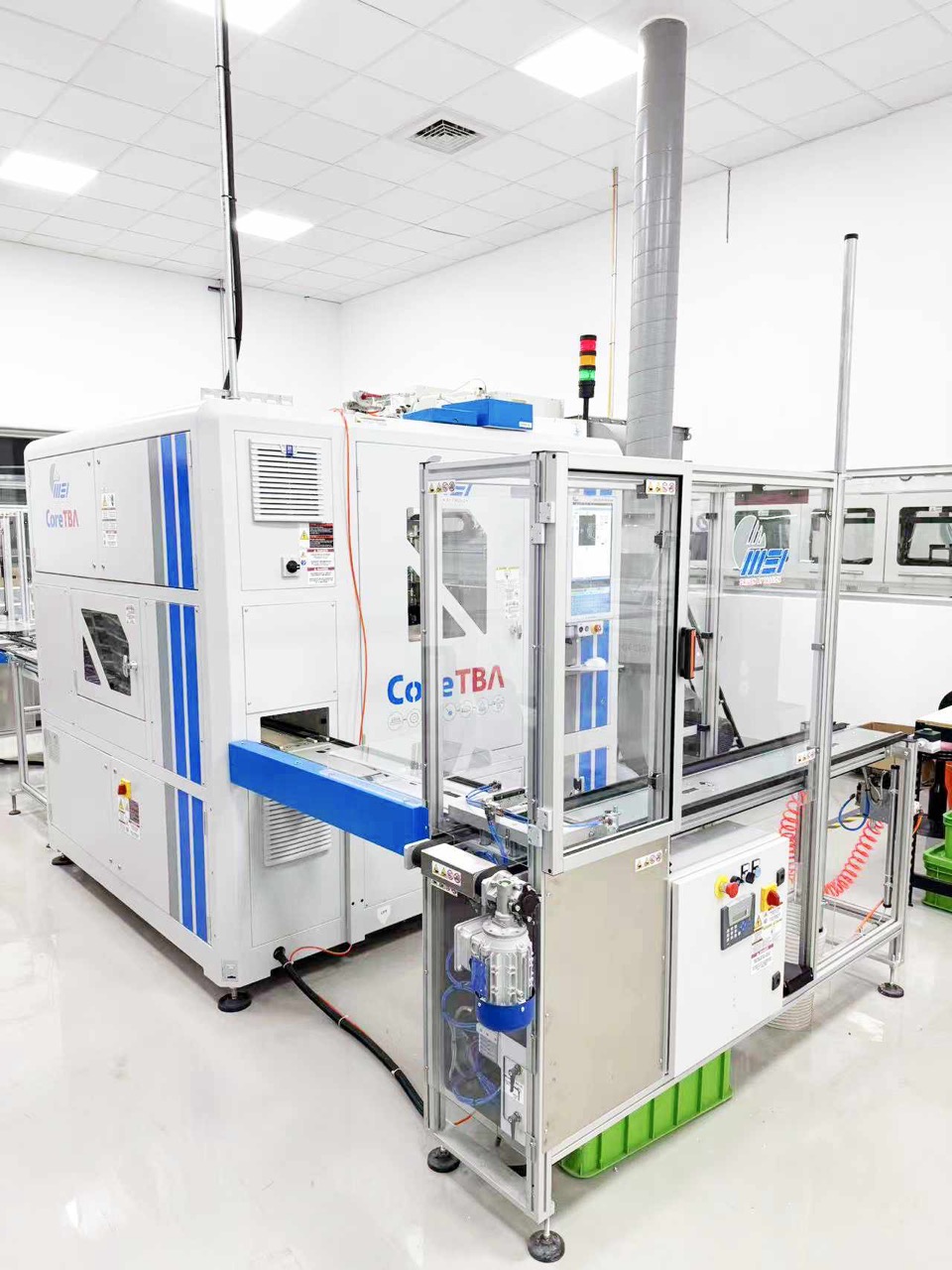
TBA technology in surfacing, as it is thought, does not create absolute limitation: it is up to the equipment manufacturer to decide which type of limitations to consider, based on priorities on power ranges and project goals. All standard lenses can be machined, and restrictions apply only in very specific cases, such as very high lens plus powers or strong prisms.
Block-less technology works where it matters the most: it envisioned the efficiency for a lab by tackling the most common type of jobs, providing effective saving in OpEx (Operating Expense) and making the investment valuable.
Aiming at producing a flying car, you wouldn’t prioritize the same load capability of a robust pick-up. Saying today that block-free has limits is like saying a phone needs a keyboard to have a future.
Current users of the machine, like Sebastien Chailley, Senior Vice President Operations & Technology, Lunetterie New Look Vision, Canada, share a similar opinion: “After working with block-less technology, it becomes clear: for newcomers, adopting it requires only a small mindset shift – nothing compared to the transition demanded by traditional surfacing”.
Other customers reported that the system was self-calibrating and could be up and running in a matter of minutes, making it a real time saver at startup. Another user said: “Initially, we were checking behind the TBA to see how accurate it was. We found out that the accuracy was great, so we no longer checked behind it.”
Advantages and current limitations of block-less manufacturing
- Eliminate non-value-added steps such as taping, blocking, de-blocking, and repeated inter-station transfers.
- Shorten lead time by concentrating the workflow on value-added operations only.
- Reduce running costs by removing entire categories of consumables and auxiliary utilities.
- Compress footprint and simplify lab layout through integrated, compact production cells.
- Enable immediate feedback and in-process control to support consistent, premium quality output.
- Limitations in specialties (bifocal, camber lenses…) management
Industry landscape: pressure on labs and new priorities
The ophthalmic industry is evolving rapidly under the influence of automation, smart manufacturing, and shifting consumer expectations. Laboratories are simultaneously required to increase throughput, maintain consistent premium quality, and reduce operational costs.
This creates a fundamental challenge: how to innovate production processes without compromising precision. Ultimately, the goal is to maximize customer satisfaction while minimizing production costs.
To address these challenges, laboratories are increasingly focusing on streamlining operations by targeting key efficiency drivers, such as the reduction of process time, footprint, energy and water consumption, and aiming at eliminating non-essential processes.
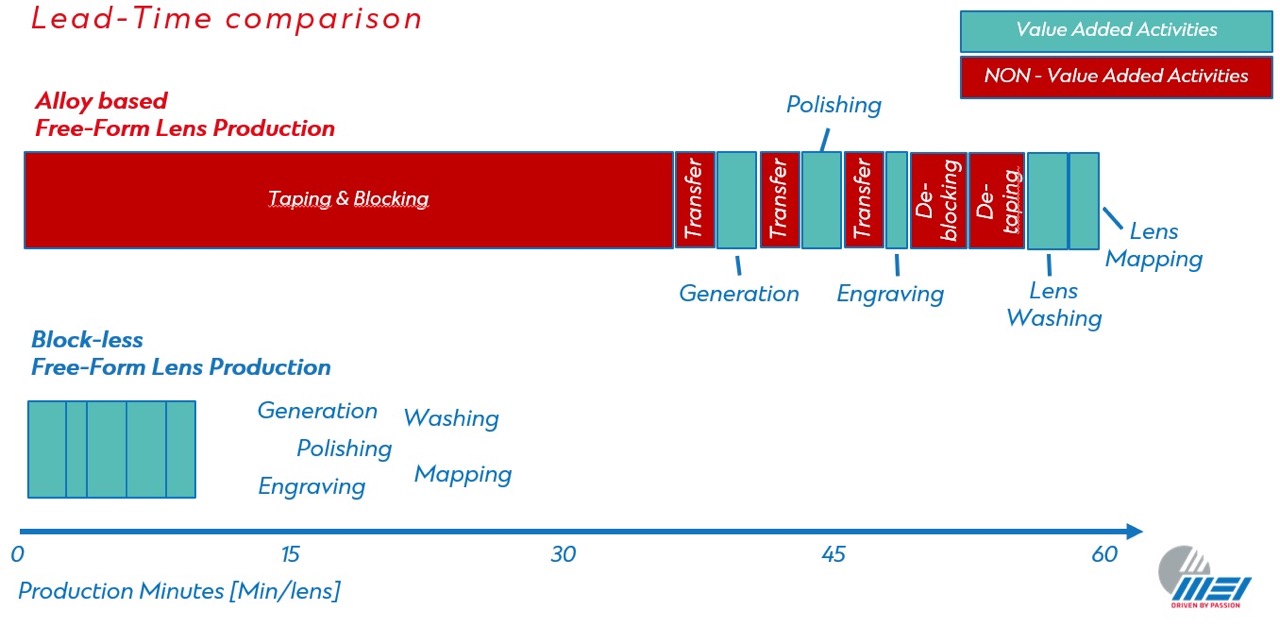
These objectives converge into a simple principle: less waiting time leads directly to higher efficiency. Only about 10 minutes are value-added in a traditional roundabout 60-minute workflow; the rest is handling and waiting.
A lead-time comparison between traditional alloy-based processing and block-less free-form production (Fig. 1) highlights how traditional workflows include multiple non-value-added stages – such as taping, blocking, de-blocking and transfers; whereas block-free production concentrates the cycle on value-added operations. Obviously, values are indicative and subject to region and technology considered.
A closer look at alloy-based production costs
The comparison between traditional alloy-based production and block-less free-form production highlights a structural inefficiency in traditional workflows, as reported in figure 1. In traditional processes, a significant portion of the total lead time is spent on non-value-added activities such as taping, blocking, de-blocking, and multiple transfers between stations. These steps do not contribute to the final lens quality, yet they heavily impact overall efficiency. By contrast, block-free production eliminates these steps entirely, focusing the process on value-added operations such as generation, polishing, and engraving.
This leads to a fundamental shift: only a fraction of the traditional production time is dedicated to actual value creation, while the rest is spent on handling and waiting. Removing these inefficiencies results in shorter lead times and more stable, predictable workflows.
Running costs: a structural reduction
Process innovation also significantly impacts the cost structure. Traditional lens production requires a broad range of consumables, including tape, alloy, blocks, and water-intensive waste management systems. Each element contributes incrementally to the cost per lens.
Block-less production removes entire categories of consumables, simplifying the cost structure and reducing operational overhead. The remaining costs are mainly linked to core processing tools and energy consumption, creating a more predictable and scalable economic model. In addition to direct savings, the simplified structure reduces logistical complexity and supports more sustainable production practices.
Footprint optimization and resource efficiency
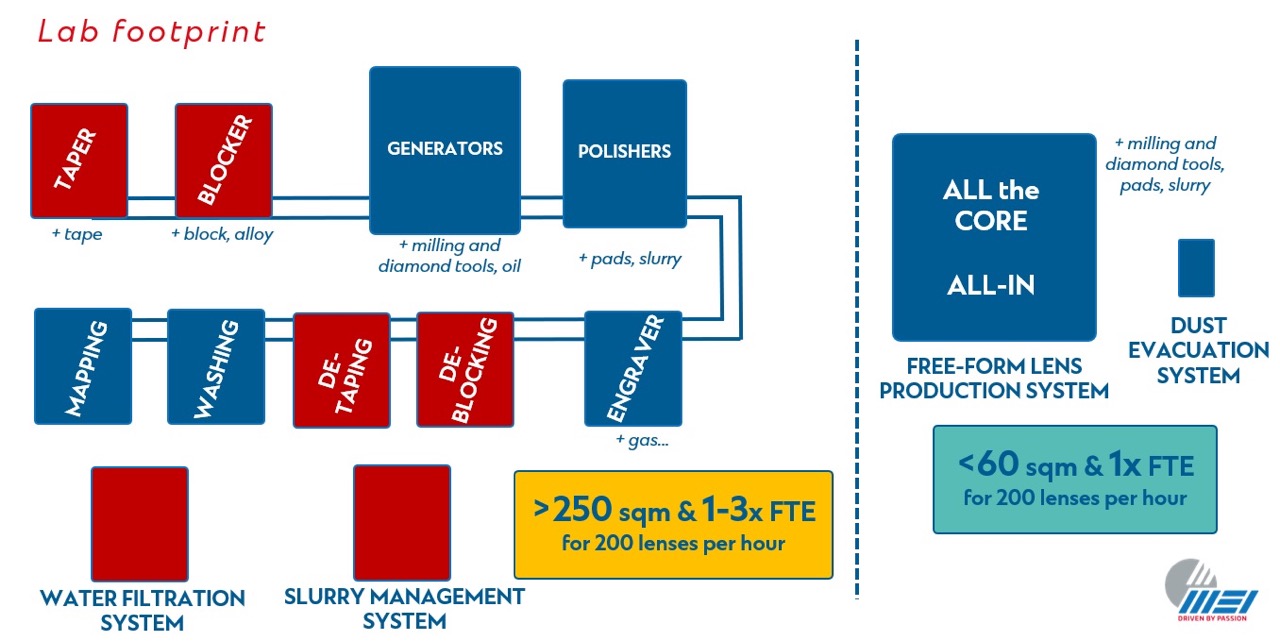
Traditional surfacing relies on a distributed workflow involving multiple machines (generators, polishers, blockers, washing units) and auxiliary systems such as water filtration and slurry management. This results in large footprints and complex material flows (see Fig. 2.).
Integrated block-free systems consolidate all operations within compact production cells, significantly reducing required space. This simplification improves layout efficiency, reduces infrastructure costs, and allows for more flexible and scalable lab configurations. According to MEI’s model calculation, labs require 75% less space for the same production volume.
From early adopters to industry standard
Technology maturity is ultimately proven through industrial adoption. The progressive increase in production volumes processed through block-free systems demonstrates a growing level of confidence across the industry.
What initially started as a solution for early adopters has evolved into a viable model for large-scale manufacturing, supporting both flexibility and high throughput requirements.
In the opinion of MEI, this shift confirms that block-free production is no longer limited to innovators but has the potential to becoming a mainstream solution for modern laboratories.
Integrated quality control and immediate feedback
A major advantage of streamlined production lies in the integration of quality control directly within the manufacturing process. Instead of relying on downstream inspection, block-free systems incorporate real-time monitoring and verification steps.
Integrated mapping, cosmetic inspection, sizing and centering controls enable operators to identify deviations immediately and implement corrective actions without delay.
This approach minimizes scrap, reduces rework, and ensures consistent product quality, enabling a transition toward self-controlled manufacturing environments.
As process integration evolves, the quality threshold is no longer defined only by the final result, but also by the speed and intelligence of in-process feedback. In that sense, the bar has been raised – not once, but again.
Conclusion – the empowered laboratory
The evolution of lens production is leading toward a new paradigm: the empowered laboratory. By integrating processes, eliminating inefficiencies, and enabling real-time control, laboratories can achieve higher productivity, lower costs, and consistent premium quality.
In this context, block-free production does not represent a future possibility, but a present reality already reshaping the competitive landscape of the ophthalmic industry.
The debate is over: block-free manufacturing works. The real cost is continuing to invest in processes that add no value.

Simone Mangili
Simone Mangili, Product Manager at MEI, works at the intersection of product development and global sales, focusing on advanced lens manufacturing technologies. He is actively involved in shaping product strategy and supporting international customers with high-performance solutions, contributing to the evolution of automated processes in ophthalmic labs. His work bridges technical innovation and commercial execution, with a strong focus on delivering tangible value to large-scale lens manufacturers.