

Putting a number on color

Can “more contrast” finally be measured?

For most of their history, sunglasses did their job by making the world darker. A newer generation of lenses works differently – and it raises a question the industry cannot yet answer with numbers. Words such as “enhanced color” and “high contrast” appear on many lens products, but there is no shared way to measure what they mean. However, by using a reimagined model for evaluating color performance, a company aims to describe color performance as objectively as light transmission and UV protection are described today.
Colorboost, a US optical technology company now expanding into Europe, proposes two metrics – the Color Resolution Factor (CRF) and the Color Accuracy Factor (CAF) – to name color performance.
From blocking light to shaping it
For most of the history of eyewear, protecting the eye meant one thing: reducing the amount of light that reached it.
From the slitted snow goggles of the Arctic peoples to the green glass worn by Venetian gondoliers and the tinted aviators of the 1930s, almost every advance was a variation on the same idea: blocking more light with darker lenses to reduce glare and eye strain.
But blocking light also blocks visual information: along with the glare, a broad tint washes out the very cues the brain relies on, such as color, contrast, depth, and fine details.
A newer approach breaks with this tradition. Instead of dimming the whole scene, Colorboost lenses filter specific wavelengths of light to produce the visual effect the wearer sees, sharpening color and contrast rather than simply darkening the view. This changes the question from how much light a lens blocks to how well it shapes the light it lets through – a property that today’s lens specifications were never designed to describe.
The claim no one can measure
For decades, a lens has been described by a small set of optical values: visible light transmission (VLT), UV protection, polarization and tint category. These remain essential. But they do not describe how a lens changes the way we see color: how well small color differences can be told apart, how contrast is perceived, or how natural colors still look.
This is why terms such as “color enhancement” and “high contrast” are now common in lens marketing, and also why they are a problem: they are not defined and not measured. Two lenses can carry the same claim and give very different results, and the wearer has no number to compare them. The stakes go beyond marketing. Color vision supports visual awareness, object recognition, depth perception and reaction time. A lens that truly raises color contrast can help people perform better in sport, at work and while driving, and can make everyday scenes look richer. The company argues that the industry now needs a color-contrast metric in the same way it already relies on Visible Light Transmission (VLT) and UV data.
A lesson from the display industry
To build such a metric, the company looked at an industry that solved a similar problem years ago: displays. Televisions moved from standard definition to High Definition (HD), to 4K, and then to High Dynamic Range (HDR). Buyers can compare picture quality because the display industry publishes clear color and contrast metrics.
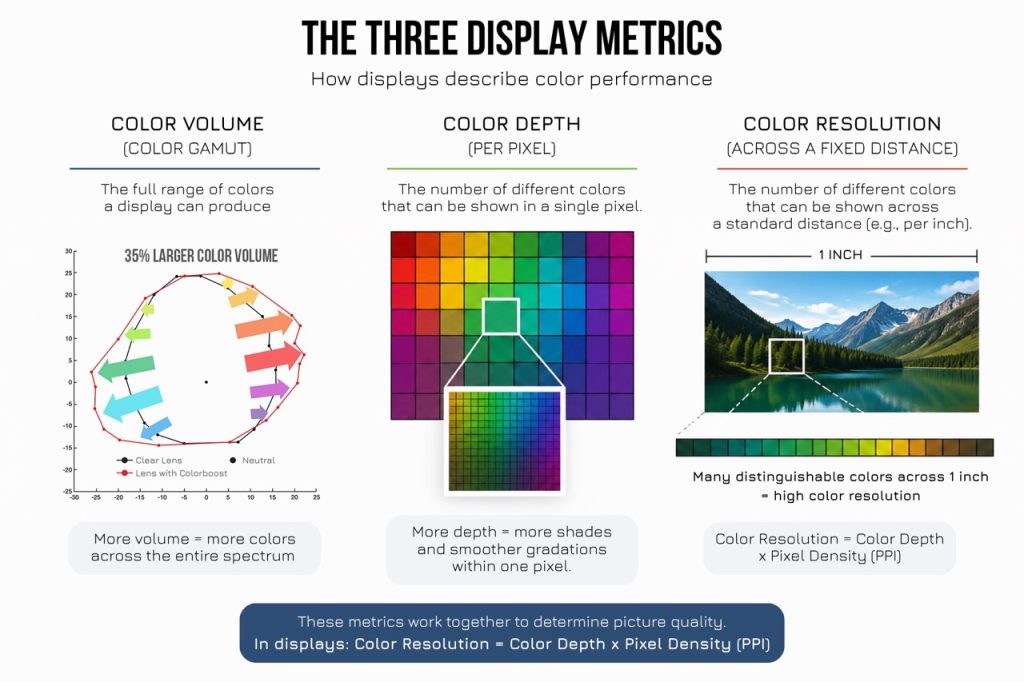
Displays are measured with several values. For example, color volume (also called color gamut) describes the full range of colors a screen can produce. Color depth describes how many different colors can be shown in a single pixel. Color resolution describes how many different colors can be shown across a standard distance – for example, per inch.
The representable color information per area depends on both the color depth and the pixel density. In this sense, both parameters influence the perceived image quality.
From pixels to lenses
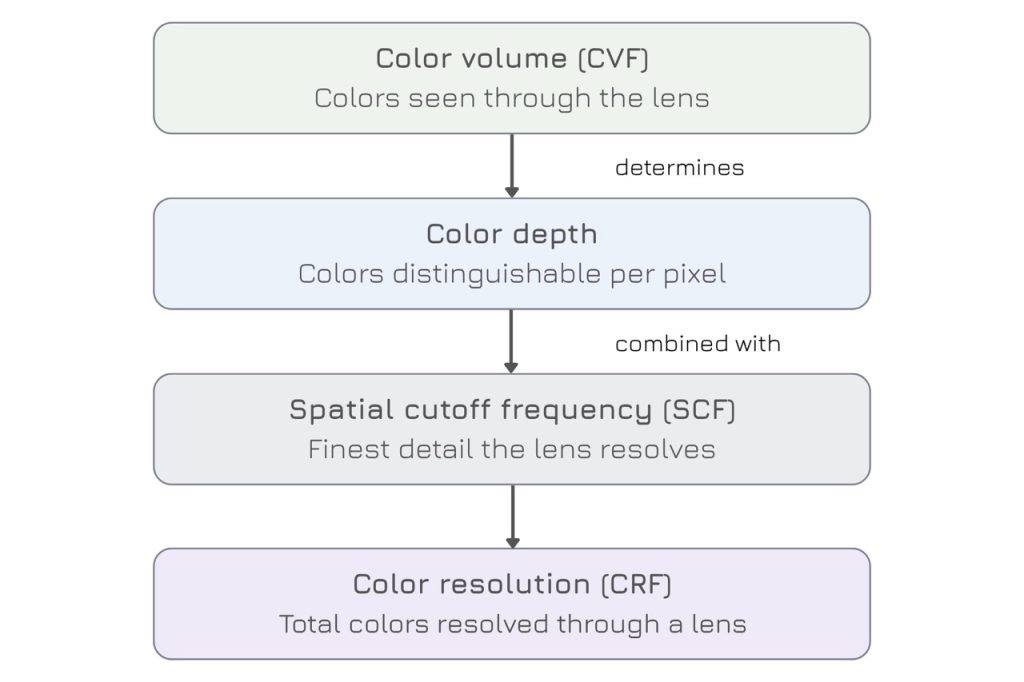
Colorboost adapts these three display values to a lens. The key step is to match a pixel to the optical resolution of a lens. The smallest element a screen can show is the same idea as the smallest detail a lens can optically resolve.
For our concept, we use the bridge of thought that the pixel density of a display corresponds to the Spatial Cutoff Frequency (SCF) of a lens – an established measure of how finely a lens resolves details.

SCF is measured in line-pairs per millimeter (lp/mm), just as pixel density is measured in PPI. A well-made polymer lens, for example, has an SCF of about 30 lp/mm. With this bridge in place, each display value has a lens version:
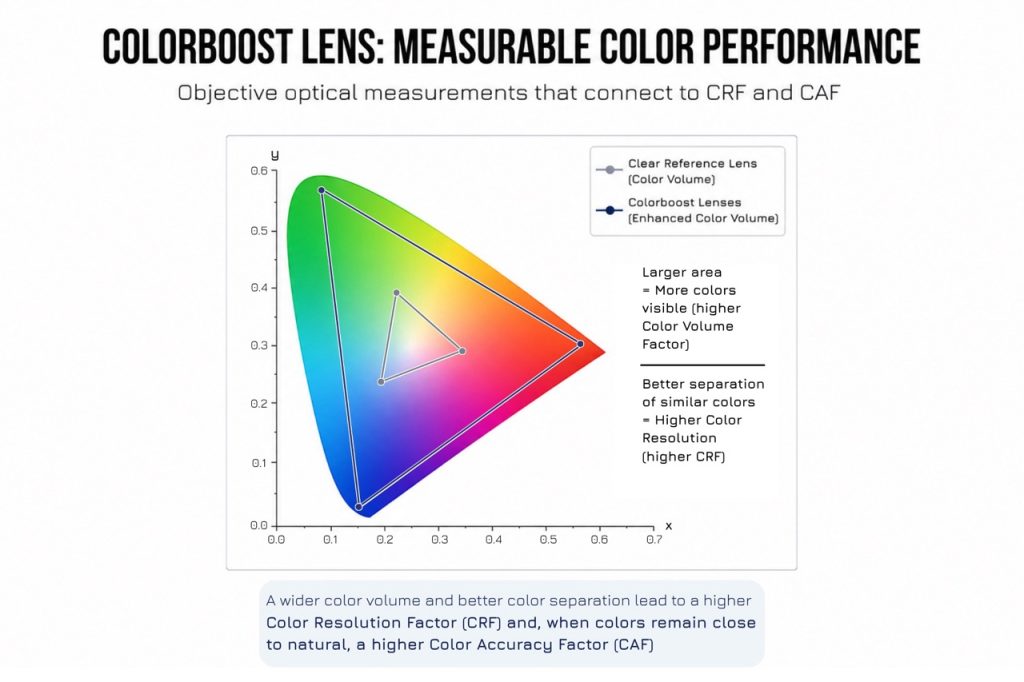
- Color volume of a lens – the range of colors seen through it. The Color Volume Factor (CVF) is this range compared with a clear reference lens.
- Color depth of a lens – the number of colors that can be told apart within the smallest resolved detail (the “per pixel” case).
- Color resolution of a lens – the number of colors that can be told apart across a standard distance, for example per millimeter. The Color Resolution Factor (CRF) is this value compared with a clear reference lens.
The CRF metric developed by Colorboost can be understood as the main measure of color contrast. Because color resolution is built from color depth and optical resolution, and color depth is built from color volume, a higher CRF means the lens delivers more saturation and more shades and hues within the detail the eye can resolve. These are exactly the qualities of a lens that people describe as “high contrast.”
The right lens also depends on the scene. An everyday urban or suburban view contains a balanced mix of warm, cool and neutral colors. Other environments – snow, desert, ocean, forest – are shifted toward one group. Colorboost lenses can be tuned to a specific environment to raise visual performance or enjoyment where it is needed most.
Two factors: CRF and CAF
History explains why two metrics are needed, not one. For a long time, a lens could raise contrast or keep colors accurate, but not both at once.
Yellow-tinted lenses, for example, increased contrast but distorted real-world color. Splitting color performance into two measures reflects that reality – and sets the goal of achieving both at the same time. The Color Resolution Factor (CRF) measures how well a lens separates colors and makes small color differences easier to see. It turns a subjective claim – “brighter” or “richer colors” – into a value that can be compared against a reference lens. Typical benefits include:
- better awareness of the surroundings outdoors,
- clearer separation of objects in sport and performance eyewear,
- easier recognition of objects, surfaces and fine detail,
- a basis for premium lens tiers defined by measured color performance.
With the Color Accuracy Factor (CAF) we measure the other side of the balance: how natural the colors remain. A good lens should enhance useful visual information without distorting the colors.
CAF describes how closely the color seen through the lens matches the original color, and it considers color shift, natural color balance, and how stable the colors stay under different viewing conditions.
| Metric | What it describes |
| Color Resolution Factor (CRF) | The ability to separate and tell apart colors – how well the lens improves color contrast. |
| Color Accuracy Factor (CAF) | The ability to keep colors natural – how closely the color seen through the lens matches the real color. |
The point of measuring both is that they must be achieved together. Colorboost designs its lenses to score highly on our concept of CRF and CAF at the same time – the combination that older tinting approaches could not reach.
How the metrics are measured
Colorbosst developed CRF and CAF based on established principles of color science, optical measurement and human visual perception. The evaluation combines the spectral transmission of the lens, color-space analysis of perceptual color differences, a defined comparison against a reference lens, controlled optical measurement conditions, and models of human vision. This can be described as an ongoing effort. The company is refining the measurement protocols through laboratory testing and optical analysis, and plans further steps such as independent laboratory testing, academic collaboration and publication of the method, so that the metrics can be adopted more widely across the industry.
A common language – and a European base
The wider aim of CRF and CAF is to move color performance from subjective description toward measurable, science-based evaluation. For lens manufacturers and eyewear brands, shared metrics offer a way to develop differentiated products, explain a real benefit to customers, and open new premium positions in optical, sun and sport eyewear.
This is also the background to the company’s expansion in Europe. After setting up its European entity, the company is bringing its patented technology closer to European optical laboratories, lens manufacturers and eyewear brands, and is looking for long-term partnerships based on technical collaboration and joint product development.
The bottom line
For two thousand years, the best a lens could do was stand between the eye and the sun. By filtering specific wavelengths rather than dimming the whole scene, and by building lenses that deliver both color contrast and color accuracy, the company plans to turn “color enhancement” from a slogan into something the industry can measure and compare.
Whether CRF and CAF become standards will depend on independent validation and broad adoption – but the shift from words to numbers is one the industry has made before, with VLT and UV.