
Rethinking lens power

Why geometry alone does not define what the wearer perceives

From surrounding media and vertex distance to tilt, gaze angle and peripheral aberration compensation – the optical effect of an ophthalmic lens is always shaped by context.
It is common to refer to the power of an ophthalmic lens as if it were an intrinsic property of the lens itself. However, this is not strictly correct. The only truly invariant features of a passive lens are, by definition, its geometry and its refractive index.
Lens power depends not only on those parameters but also on the refractive index of the surrounding medium. A useful example is that of an intraocular lens (IOL). Measured in air, its effective power is around 60 diopters, whereas once implanted in the eye – surrounded by aqueous humor anteriorly and vitreous humor posteriorly – its effective power is reduced to approximately 20 diopters. The physical lens is the same, yet its optical effect changes because the environment has changed.
A related thought experiment helps clarify the same principle. Consider a biconvex lens made of a material with a refractive index lower than that of water (n < 1.33). In air, its power would be positive, but when immersed in water it would become negative, even though its biconvex geometry remains unchanged. This is also why vision becomes blurred when we open our eyes underwater in a swimming pool. The cornea loses almost all of its refractive power, and the eye becomes hyperopic in functional terms.
Lens power depends on optical context
The situation becomes even more complex when an ophthalmic lens is placed in front of a patient’s eye. In that context, it is no longer an isolated optical element. It becomes part of the ocular optical system, where not only the individual powers of each element matter, but also their relative positions.
In clinical practice, this effect is addressed through vertex distance adjustment, which compensates for the difference between the nominal power of the lens and the effective power resulting from its position relative to the eye. The magnitude of the adjustment depends on how much the lens position changes and on how high its optical power is. The stronger the lens and the larger the positional difference, the more relevant the effect becomes in daily dispensing.
In summary, the power of a lens depends on the surrounding medium and, if it is part of a system, on its relative position to the other elements. In the case of ophthalmic lenses, the first observation is usually irrelevant because lenses are used in air. Vertex distance adjustment, however, may be necessary in high-power prescriptions where the difference between the vertex distance used during refraction and that of the final eyewear is significant.
Position of use and the limits of central measurements
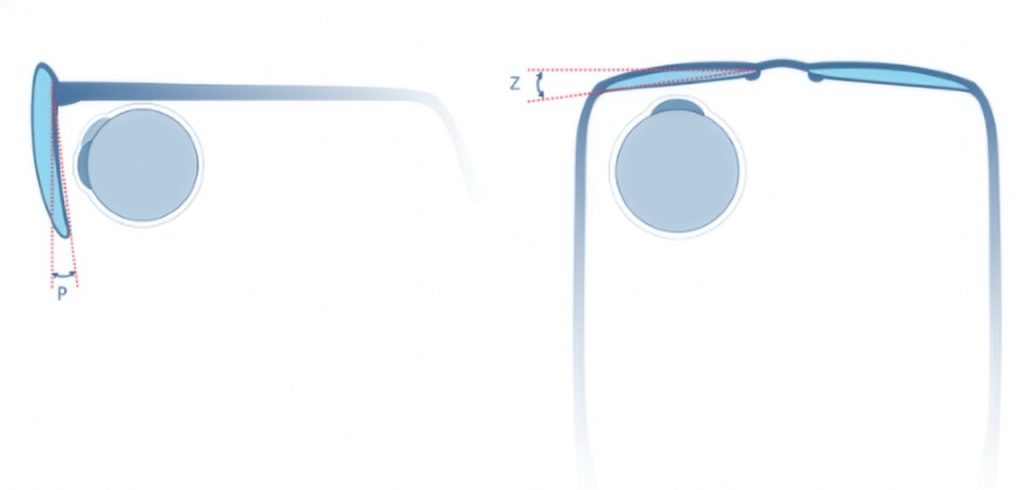
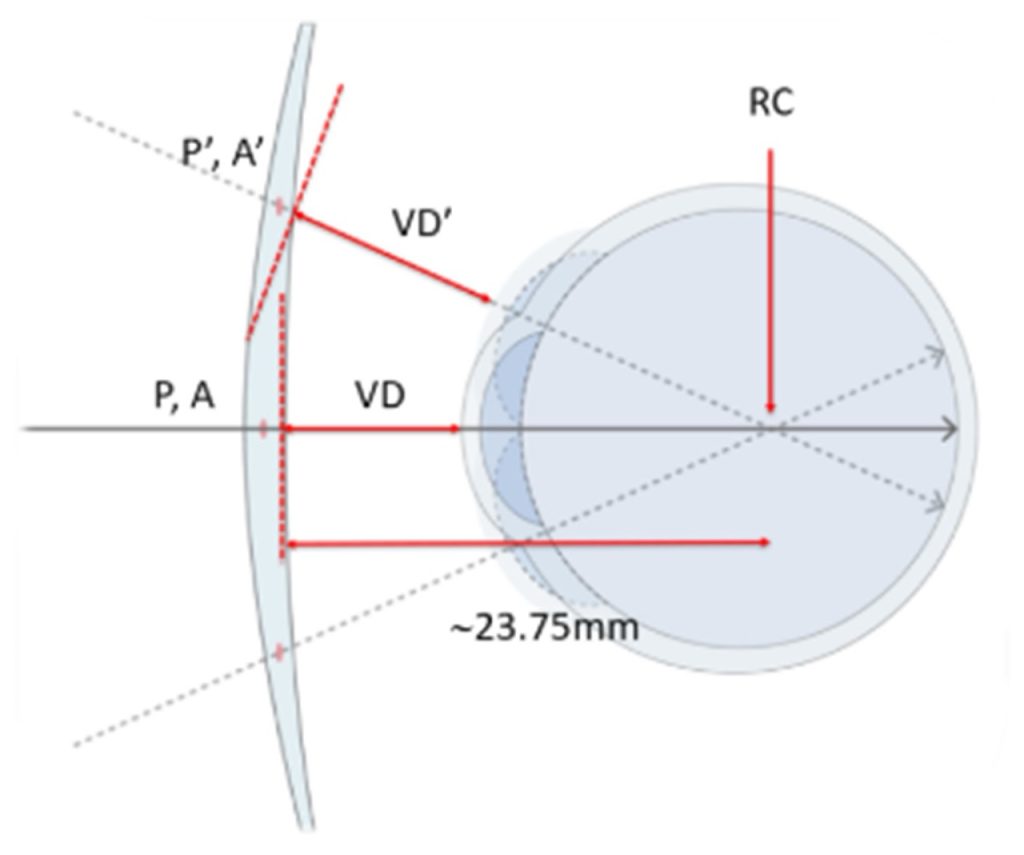
Over the last two decades, with the development of free-form technology generators, algorithms have been created to adjust the optical power of a lens to its position of use. “Position of use” refers not only to vertex distance, but also to panoramic and pantoscopic angles. The effective power of a lens changes depending on whether it is tilted relative to the rest of the optical system. Therefore, these algorithms adjust the lens so that, once fitted in front of the patient’s eye, the perceived power is as close as possible to the prescribed power.
At first glance, one might conclude that if a lens is positioned at the correct vertex distance and with zero pantoscopic and panoramic angles, no additional geometric compensation would be needed to improve optical quality. But this is not the case. The key lies in the fact that the angles usually measured in dispensing correspond only to the optical center of the lens.
When the patient looks through the periphery of the lens, gaze becomes oblique. As a result, the perceived power changes significantly relative to that measured at the center. The change does not affect only spherical power. It also introduces unwanted astigmatism and can generate higher-order aberrations such as coma. In practical terms, this means that a lens that appears correct in a central measurement may still perform differently across the visual field actually used by the wearer.
Oblique aberrations and Tscherning’s Ellipse
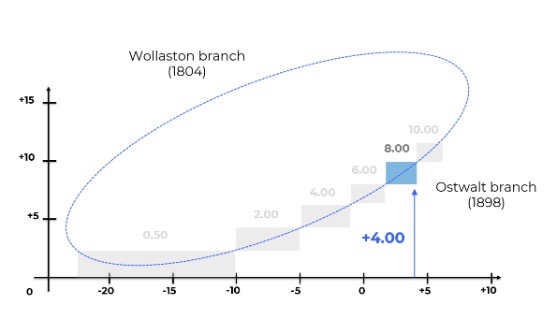
The magnitude of these peripheral changes depends on the gaze angle and on the base curve used to design the lens. This relationship has been known for more than a century and is summarized by Tscherning’s ellipse. In 1890, the Danish optician Marius Tscherning described the combinations of back vertex power and base curve that minimize oblique aberrations.
According to this principle, for example, a +4.00 D lens should ideally be produced with an 8.00 D base curve. In practice, however, the optimal curve is rarely applied. Aesthetic constraints, frame selection, manufacturing preferences and fitting considerations often lead to flatter or otherwise compromised forms. Consequently, the patient may perceive significant peripheral aberrations even when the central prescription is correct.
This has important implications. In a monofocal lens, the visual field may be narrower or of lower quality than expected. In a progressive addition lens, oblique aberrations can directly influence adaptation success or failure. For this reason, central power alone is an incomplete descriptor of the user’s real experience.
Why peripheral compensation matters
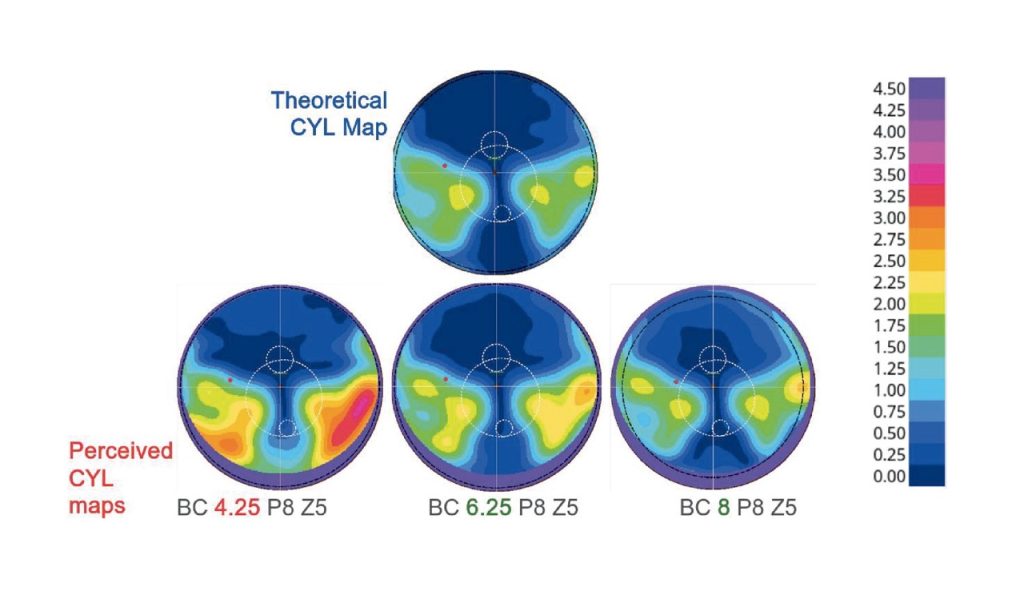
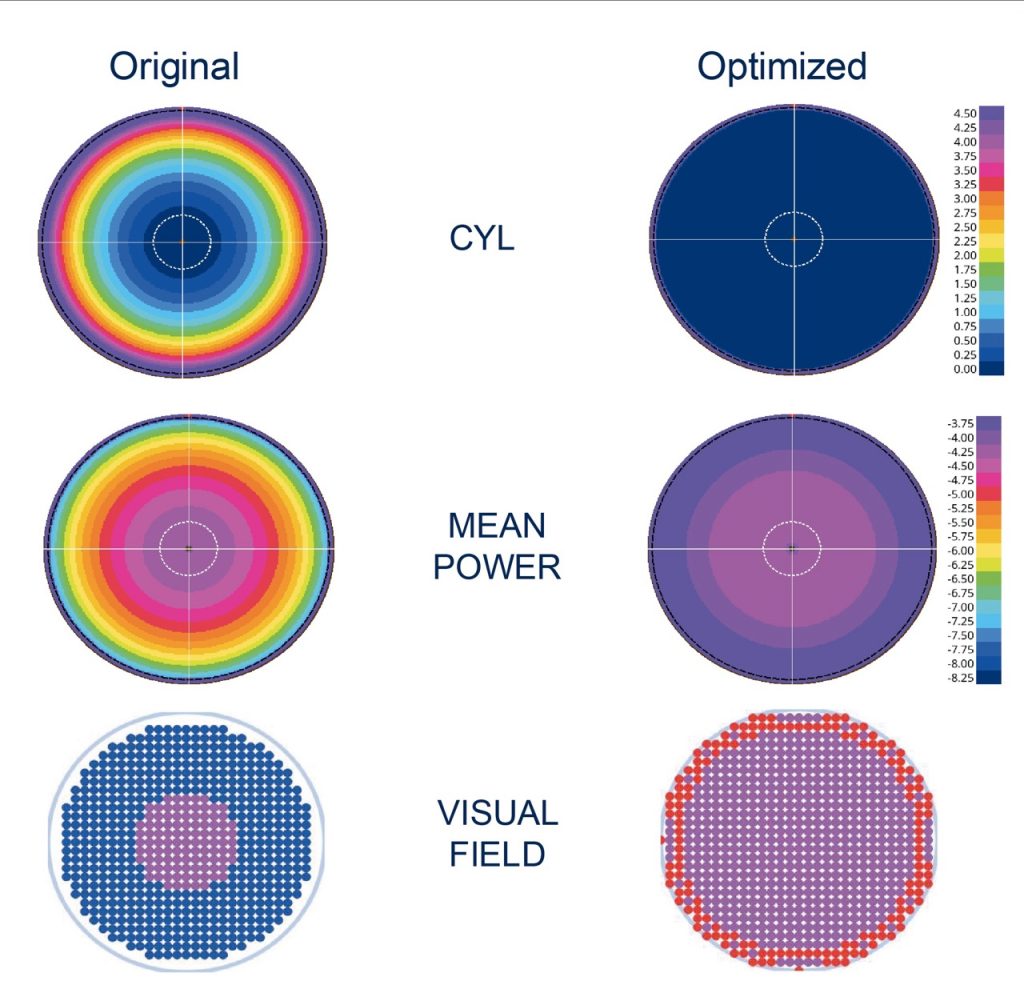
It is precisely in these cases that peripheral aberration compensation technologies, based on generalized ray tracing and wavefront analysis, become essential. These methods predict the optical aberrations perceived by the user at every point of the lens and adaptively modify the inner surface so that, with the chosen base curve and the real position of use, oblique aberrations are minimized.
This approach is commonly referred to as personalized design, although the term can mean different things depending on the manufacturer. In optical terms, its real value lies in compensating for what the wearer actually perceives under realistic conditions of use, not merely in customizing a lens according to marketing language or wearer lifestyle categories.
The result of these compensations is that both monofocal and progressive addition lenses can offer wider visual fields and higher optical quality. In some cases, the improvement in usable visual area is substantial enough to redefine the wearer’s practical visual comfort, especially in dynamic tasks involving frequent eye movements.
Lensmeter readings versus perceived performance
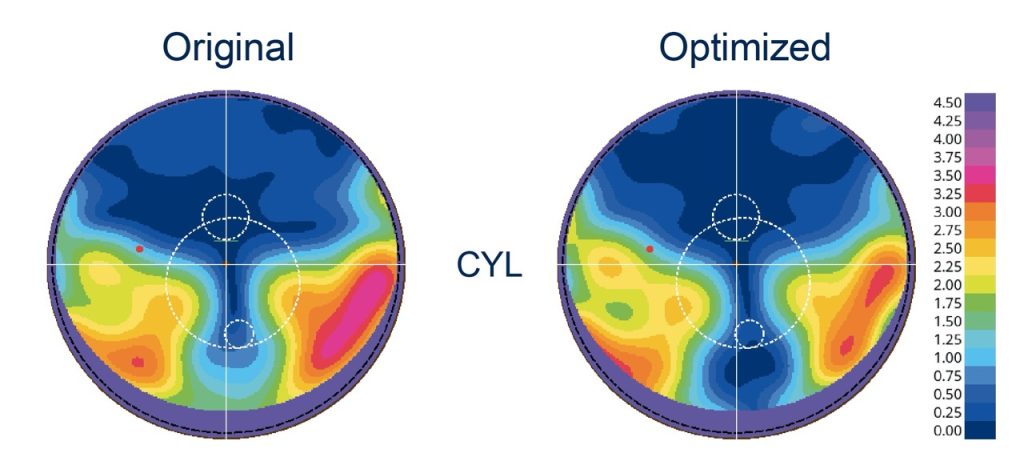
A relevant side effect of these compensations is that the spherical power and astigmatism measured with a lensmeter do not exactly match the prescribed values. This sometimes generates confusion when one expects the lensmeter reading to coincide exactly with the ordered prescription.
The explanation is straightforward. A lensmeter evaluates the lens from an angle that differs from the direction used by the wearer when looking through it. In other words, the instrument measures one optical condition, while the wearer experiences another. The discrepancy between both measurements increases as the angles of use become greater and as the chosen base curve deviates further from the optimal curve predicted by Tscherning’s ellipse.
This distinction is particularly important in technical communication within the ophthalmic industry. If a compensated lens is assessed only through conventional central instrumentation, its measured values may appear unusual, even though its real optical performance for the wearer is better. That is not an error in the lens design. It is the consequence of optimizing the lens for perceived vision rather than for a simplified measuring geometry.
A more useful definition of lens power
As we have seen, the power of a lens is not an intrinsic property but the result of its interaction with the surrounding medium, its position in the ocular system and the gaze angle through which it is used. The conventional habit of describing a lens as if its power were fixed and self-contained is useful for shorthand communication, but it is conceptually incomplete.
A more accurate understanding is especially relevant today, when free-form production, compensated geometries and personalized calculations allow the industry to move beyond nominal values and toward perceived performance. The future of ophthalmic optics depends not only on manufacturing lenses with the correct prescription, but on designing them so that the wearer experiences that prescription as intended under real conditions of use.
Reinterpreting the famous Spanish philosopher Jose Ortega y Gasset, one could say that, in terms of power, the lens is itself and its circumstance.