

A new framework for low vision care in Ghana’s Ashanti region
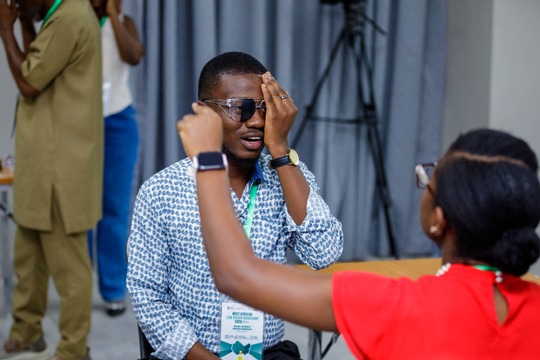
The joint “Low Vision” project between Munich University of Applied Sciences (HM) and Kwame Nkrumah University of Science and Technology (KNUST) in Ghana has established a three-tiered care system for people with visual impairments in the Ashanti Region: a cornerstone for sustainable care for people with visual impairments in Ghana and throughout sub-Saharan Africa.
Visual impairment affects millions of people worldwide – yet in Ghana and large parts of sub-Saharan Africa, adequate treatment options are often lacking. This is precisely where the “HM KNUST Low Vision Project” came in: The goal was to close gaps in care by providing on-site practicing optometrists with specialized low-vision training. In parallel, studies on evidence-based practice were conducted, and a platform was developed to facilitate access to eyeglasses and magnifying visual aids. The project expanded low-vision care in Ghana.
From the university hospital to the health center
Since the project began in 2023, HM Professor and Project Leader Werner Eisenbarth from the Faculty of Applied Natural Sciences and Mechatronics and Dr. Kwadwo Owusu Akuffo, Senior Lecturer at KNUST, have jointly developed and implemented a three-tiered care model.
“The goal was to establish the WHO’s International Vision Rehabilitation Standards in a pilot project in Ghana,” said Eisenbarth.
Technical equipment for diagnostics and training was purchased for the university hospital in Kumasi. Three district hospitals with ophthalmology departments also received modern equipment. At the level of rural health centers, so-called “ophthalmic nurses”—staff specifically trained in ophthalmology—were equipped with low-vision testing tools. This was accompanied by digital continuing education programs as well as accompanying scientific research that continuously documents the model’s effectiveness.
Training, care, and new opportunities
The project’s results are far-reaching: In the future, four low-vision clinics will be able to treat approximately 400 patients per year. Each year, about 100 optometry students will receive comprehensive training in low-vision rehabilitation. Through continuing education programs—so-called “Continuing Professional Development Courses” (CPD)—individuals with knowledge of optometry and ophthalmology, as well as therapists, will also receive further training. According to Professor Eisenbarth, the goal was to improve student training in order to sustainably enhance care for patients with visual impairments in Ghana: “In the Ashanti Region, there are now four established care centers to which patients can be specifically referred. Until this project, many patients—and in some cases optometrists as well—were unaware of the specific rehabilitation options available for visually impaired patients.
The project has thus not only established infrastructure but also raised public awareness: visual impairment is not an inevitable fate, but a solvable healthcare challenge. HM and KNUST intend to continue their collaboration and make the developed model available as a blueprint for other regions in sub-Saharan Africa.
“We are currently conducting a pilot study on early glaucoma detection in young adults, as we have found that approximately 20 percent of patients with visual impairment due to glaucoma are 30 years old or younger. This is a clear mandate to strengthen early detection of this irreversible disease of the optic nerve. We are therefore currently working on a proposal for a follow-up project designed to address this issue,” said Eisenbarth